In the days before golf became a pathway to fame and fortune many talented young players decided against pursuing the game professionally in order to follow more lucrative and respectable careers. Like refuse collector. Or pawn broker. The great Bobby Jones remained an amateur is entire career. Francis Ouimet won the US Open but honored his promise to his parents never to turn pro (of course this was in the days when professional golfers were not allowed in the same club house as the "gentlemen" members). My wife's uncle was an outstanding collegiate golfer, but chose to take over the family travel agency rather than pursue a professional golf career. (Of course most of the above mentioned men were relatively affluent. I still love Lee Trevino's quote on the eve of the final round of the Open Championship in England; when Trevino, who grew up in poverty, was asked if the pressure of the situation might get to him he smiled and said something to the effect of, "This isn't pressure. Pressure is when you're playing for 20 dollars a hole and you only have 2 dollars in your pocket.")
Another guy who gave up a potentially lucrative - and certainly historic - golf career in favor of going into the "family business" was none other than the dear little leader himself, Kim Jong-Il. (Stay with me here.)
It seems that in about 1994 the Kimster played an 18 hole round of golf in 38 strokes under par. If par was the standard 72 strokes, that means he fired a 34. By way of comparison, the record round for a PGA tour - comprising the best players the world has ever seen - round is either 58 or 59 - I'm too lazy to look it up. Kim's round included not one, not two, not three, but 11 holes in one. Now, before you get all skeptical on me you should know this: Kim's historic round of golf was verified by both the official North Korean news agency and all seventeen bodyguards who followed him on the round. If you can't believe 17 guys whose next meal - and life - depends on the answer they give, who can you believe?
Now you might ask: how many years did the dear leader need to practice in order to reach this pinnacle, this surpassing level of performance? Zero. Apparently, this was his first round of golf ever. I know, it very nearly defies belief! Imagine what he could have done with a little practice. It's not unrealistic to think that a perfect 18 might have been within the reach of a player so prodigiously - almost supernaturally - talented. Heck, he might have even found a way to complete 18 holes in fewer than 18 strokes (perhaps splitting the ball with his driver and sinking each half in two different holes). If anyone could have done it, it would be L'il Kim.
By the time Kim humbled that North Korean course, professional golf had become pathway to millions of dollars. So one can only admire all the more the complete selflessness Kim displayed when, just like Alice's uncle, he decided to forgo a pro golf career and take over the family business at a critical time.
Unfortunately for the people of North Korea, the Kim family business was starving millions of people to death, and imprisoning, torturing and executing most of those who survived.
We have seen a lot of sadistic dictators. We have seen more than a few messianic dictators. But rarely has there been a dictator as batpoo/port-a-john rat crazy as Kim. That's because the only way someone that batpoo crazy gets to be a dictator is if his much more intelligent, enormously sadistic, completely messianic, and (very) slightly less batpoo crazy father secures the job for him. (And if he's willing to turn his back on a golf career.)
Starving people on that scale takes some real effort. All the more so in a land that stands as pretty much the last place on earth where acorns comprise a significant portion of the diet, and which still has "has" in the case of South Korea, "had" in the case of North Korea) an acorns-as-food industry. Starving people on that scale requires completely divorcing people from a longstanding and proven source of nutrition, making them utterly dependent upon grain crops, and then failing to provide the infrastructure to a) distribute those grain crops to the people and b) protect grain stores from floods and other unusual - but thoroughly predictable - disasters. It need not be said that famines are of course good for the dictatorship business (see also Mao Pse-tung and Joseph Stalin) in terms of consolidating power.
Control the food and you control the populace. Food = power.
We have the opposite situation in the US. The government isn't (intentionally) starving people. Instead it is paying grain farmers to grow more corn than the populace can possibly eat, and then subsidizing the food industry's efforts to cram more of that cheap corn down our willing maws. Here's a tip kids: You want job security in the future, become a physician specializing in diabetes.
The point I'm laboring to make here is that reliance on annual grain crops as our stable food source a) frees up more of our time for other leisure pursuits - like warfare - and b) allows the power hungry to alternatively starve or stuff us - whichever is most effective in achieving their goals and consolidating their power.
People who grow/gather their own food cannot be controlled as easily. Which would free up more time for the Kim Jung-il's, Joseph Stalins, Mao Tse-tung's and ConAgra's (yes I did just group them together) of the world for other leisure pursuits.
Like golf.
Kim's demise makes me wish I believed in a just and proportionate afterlife.
Showing posts with label balanoculture. Show all posts
Showing posts with label balanoculture. Show all posts
Wednesday, December 28, 2011

Tuesday, February 15, 2011
When (Balano)Cultures Collide
Great story, wrong tree.
I have been meaning to write this post for months. The person who introduced me to the story and who knew I planned to write about it was probably starting to wonder if I'd ever get around to it. (Now that I finally have he can skip straight from anticipation to disappointment with the result.)
For background material I am working primarily from a Wiki page, which is always a bit iffy, but is even more so in the case because the entry on this topic is written with the tortured syntax and creative comma use of a 6th grade book report (actually that's an insult to 6th grade book reporters everywhere, including in my house)... so my apologies for any inaccuracies. But here goes...
In about 1798-1800 a boy named Sem-Yeto was born into the Suisunes tribe, near Suisun Bay, California. He would grow into a giant of a man - 6'7" tall by all accounts - and would live through times of tectonic changes for his people - and appalling tragedy.
In 1810, two months after most of the adult males of his tribe were wiped out in a raid by Moraga, ten or twelve year old Sem-Yeto was baptized at the San Francisco Mission and was re-christened Francisco Solano. We don't know if he was taken as a prisoner in the raid, or if the survivors of the raid brought him to the mission to live. The raid had demoralized the tribe and many chose to move to the mission in surrender. However, the surviving members of the tribe didn't move to the mission permanently until a year after Solano's baptism, giving credence to the theory that he had indeed been taken captive in the raid.
In 1823 he moved to present day Sonoma to help build the Mission San Francisco de Solano, the final Spanish mission north of San Francisco. Many of his fellow Suisunes joined him, a move which brought them closer to their homeland. By this time Sem-Yeto was known as Chief Solano. He was not a chief in the true hereditary sense, but he became a leader of his decimated people.
In 1835 General Mariano Guadulupe Vallejo was dispatched to secularize the Sonoma Mission, disperse the mission's properties (mostly to himself), and maintain military control over the area. Solano became Vallejo's ally in the effort to pacify the tribes of the area; in some cases he led raids in cooperation with the Spanish, but more often his role was that of an emissary between the Spanish and the native people in hopes of maintaining peace.
Born into a time of war and turbulence, having lost dozens of loved ones to a seemingly unbeatable foe, possibly having been taken hostage, and attaining a position of responsibility for the welfare of his people, I can only imagine the crushing weight Sem-Yeto had to carry, and the difficult decisions and trade offs he was forced to make in their interest.
Sem-Yeto faced the tragic no-win decisions faced by so many Native American leaders before and since. The arrival of these strangers from overseas brought diseases which ravaged indigenous populations, shook their traditional beliefs and shifted the fragile balances of power betweening neighboring tribes. Their arrival also brought new technologies that offered the promise of an easier life, but the curse of the loss of cultural identity and ancient tradition that formed the basis of their self image.
One aspect of the Suisunes' cultural identity, of course, was his people's reliance on acorns for nourishment. Converting indigenous people from an acorn-based diet - a balanoculture - to reliance on farmed grain crops was a means of pacifying them. People who are forced to live in one place and constantly tend their fields are a whole lot easier to keep an eye on and control than people who roam freely over the land to exploit the seasonal bounty of different habitats.
And so it still is today.
And of course, the arrival of the Spanish brought a new religion, impressive in its pagentry and ritual splendor and no doubt enormously appealing with its promise of eternal life.
A small pox outbreak in 1837 decimated the Indian population north of San Francisco. Solano, one of the few Native Americans to be vaccinated, survived the epidemic. He was one of only two Native Americans to be given a land grant by Vallejo - four square leagues. One source says that as he neared death he sold the land to Vallejo for $1,000. In the end the land ended up in the possession of Archibald A. Ritchie and J.H. Fine - forever out of indigenous hands.
Last fall I was visiting a reader, friend, and producer of gourmet acorn-fed pork in Solano County and he told me a bit of the story and mentioned that Sem-Yeto had been buried beneath a massive oak tree on the campus of Solano Community College. I followed his directions and saw this magnificent tree, a valley oak (I think - I'm still learning my California oaks):


Here's a closer look:


I have been meaning to write this post for months. The person who introduced me to the story and who knew I planned to write about it was probably starting to wonder if I'd ever get around to it. (Now that I finally have he can skip straight from anticipation to disappointment with the result.)
For background material I am working primarily from a Wiki page, which is always a bit iffy, but is even more so in the case because the entry on this topic is written with the tortured syntax and creative comma use of a 6th grade book report (actually that's an insult to 6th grade book reporters everywhere, including in my house)... so my apologies for any inaccuracies. But here goes...
In about 1798-1800 a boy named Sem-Yeto was born into the Suisunes tribe, near Suisun Bay, California. He would grow into a giant of a man - 6'7" tall by all accounts - and would live through times of tectonic changes for his people - and appalling tragedy.
In 1810, two months after most of the adult males of his tribe were wiped out in a raid by Moraga, ten or twelve year old Sem-Yeto was baptized at the San Francisco Mission and was re-christened Francisco Solano. We don't know if he was taken as a prisoner in the raid, or if the survivors of the raid brought him to the mission to live. The raid had demoralized the tribe and many chose to move to the mission in surrender. However, the surviving members of the tribe didn't move to the mission permanently until a year after Solano's baptism, giving credence to the theory that he had indeed been taken captive in the raid.
In 1823 he moved to present day Sonoma to help build the Mission San Francisco de Solano, the final Spanish mission north of San Francisco. Many of his fellow Suisunes joined him, a move which brought them closer to their homeland. By this time Sem-Yeto was known as Chief Solano. He was not a chief in the true hereditary sense, but he became a leader of his decimated people.
In 1835 General Mariano Guadulupe Vallejo was dispatched to secularize the Sonoma Mission, disperse the mission's properties (mostly to himself), and maintain military control over the area. Solano became Vallejo's ally in the effort to pacify the tribes of the area; in some cases he led raids in cooperation with the Spanish, but more often his role was that of an emissary between the Spanish and the native people in hopes of maintaining peace.
Born into a time of war and turbulence, having lost dozens of loved ones to a seemingly unbeatable foe, possibly having been taken hostage, and attaining a position of responsibility for the welfare of his people, I can only imagine the crushing weight Sem-Yeto had to carry, and the difficult decisions and trade offs he was forced to make in their interest.
Sem-Yeto faced the tragic no-win decisions faced by so many Native American leaders before and since. The arrival of these strangers from overseas brought diseases which ravaged indigenous populations, shook their traditional beliefs and shifted the fragile balances of power betweening neighboring tribes. Their arrival also brought new technologies that offered the promise of an easier life, but the curse of the loss of cultural identity and ancient tradition that formed the basis of their self image.
One aspect of the Suisunes' cultural identity, of course, was his people's reliance on acorns for nourishment. Converting indigenous people from an acorn-based diet - a balanoculture - to reliance on farmed grain crops was a means of pacifying them. People who are forced to live in one place and constantly tend their fields are a whole lot easier to keep an eye on and control than people who roam freely over the land to exploit the seasonal bounty of different habitats.
And so it still is today.
And of course, the arrival of the Spanish brought a new religion, impressive in its pagentry and ritual splendor and no doubt enormously appealing with its promise of eternal life.
A small pox outbreak in 1837 decimated the Indian population north of San Francisco. Solano, one of the few Native Americans to be vaccinated, survived the epidemic. He was one of only two Native Americans to be given a land grant by Vallejo - four square leagues. One source says that as he neared death he sold the land to Vallejo for $1,000. In the end the land ended up in the possession of Archibald A. Ritchie and J.H. Fine - forever out of indigenous hands.
Last fall I was visiting a reader, friend, and producer of gourmet acorn-fed pork in Solano County and he told me a bit of the story and mentioned that Sem-Yeto had been buried beneath a massive oak tree on the campus of Solano Community College. I followed his directions and saw this magnificent tree, a valley oak (I think - I'm still learning my California oaks):

(click to enlarge)
Incredible. Beneath the tree is a plaque:

Here's a closer look:

(Click to enlarge & read)
Oops. A little more research when I got back home revealed to me that this is not Sem-Yeto's burial site at all, but that of one of his brethren. There is a different marker somewhere else on campus:

(Click to enlarge)
This history, however, claims the exact location of Sem-Yeto's grave remains unknown. I will have to visit again the next time I'm in that area... and like Paul Harvey I'll give you The Rest of the Story.
Monday, January 24, 2011
Manna From Heaven
Of course the phrase manna from heaven has an oak-rooted origin, but actually that's another story for another day.
For purposes of this post the phrase manna from heaven is the answer to the question, "What do you call it when one of your heroes sends you Korean acorn noodles in the mail?" It's better than Christmas. It's... well... that manna thing.
And it works out great, because boiling noodles is the one and only thing I can do in a kitchen! There's no easier way to be an accidental balanophage (too rushed for time to link - look it up ;-) than having noodles show up ready to be boiled.
The question now is: What sauce goes best with acorn noodles? I'm open to suggestions!
For purposes of this post the phrase manna from heaven is the answer to the question, "What do you call it when one of your heroes sends you Korean acorn noodles in the mail?" It's better than Christmas. It's... well... that manna thing.
And it works out great, because boiling noodles is the one and only thing I can do in a kitchen! There's no easier way to be an accidental balanophage (too rushed for time to link - look it up ;-) than having noodles show up ready to be boiled.
The question now is: What sauce goes best with acorn noodles? I'm open to suggestions!
Wednesday, November 3, 2010
Great Primer on Acorn Prep
Eli Sangor, one of the moderators of the University of Minnesota Extension's excellent My Minnesota Woods discussion board, contibuted a post to a thread on acorns as food that I started a while ago. Eli's post gave a link to this site, which gives one of the best overviews and primers on processing acorns for food.
Some great excerpts (bold text added by me) from the blog post Eli links to:
"Acorns are THE most consumed human food source in history. Are you listening? That means that, as a species, we’ve eaten acorns more than corn, more than wheat, more than rice."
"And, as I learned, there are many reasons why they’re an awesome food source:
1. Acorns are incredibly healthy, and they’ll fill you up quick.
2. Oak trees have enormous yields – one tree will create up to 200-300 pounds of edible acorn goodness in a season.
3. Oak trees are hardy as hell.
4. Oak trees grow all over the world.
5. Acorns are deeeee-licious."
"Step Five: Consummation...
This step was pretty awesome. We each packed up a cup of acorn flour to take home, and with the rest we made acorn dumplings (which looked exactly like poo), acorn pizza crust and an acorn loaf, somewhat the same consistency as banana bread. We were going to make pancakes, but everyone was full. We also talked about ways to work acorn flour into everyday recipes replacing some of the white flour content with acorn flour for greater protein and nutrition generally. Julie regaled us with stories of their other successes, including acorn muffins, acorn waffles, and an acorny topping for apple crisp. Yum."
(Looking "exactly like poo" is probably not something we balanophages want to tout moving forward. Deeeee-licious is probably a little more helpful.)
Yum indeed. Good motivation for me to get grinding on my own stockpile of acorny goodness waiting in the fridge!
Some great excerpts (bold text added by me) from the blog post Eli links to:
"Acorns are THE most consumed human food source in history. Are you listening? That means that, as a species, we’ve eaten acorns more than corn, more than wheat, more than rice."
"And, as I learned, there are many reasons why they’re an awesome food source:
1. Acorns are incredibly healthy, and they’ll fill you up quick.
2. Oak trees have enormous yields – one tree will create up to 200-300 pounds of edible acorn goodness in a season.
3. Oak trees are hardy as hell.
4. Oak trees grow all over the world.
5. Acorns are deeeee-licious."
"Step Five: Consummation...
This step was pretty awesome. We each packed up a cup of acorn flour to take home, and with the rest we made acorn dumplings (which looked exactly like poo), acorn pizza crust and an acorn loaf, somewhat the same consistency as banana bread. We were going to make pancakes, but everyone was full. We also talked about ways to work acorn flour into everyday recipes replacing some of the white flour content with acorn flour for greater protein and nutrition generally. Julie regaled us with stories of their other successes, including acorn muffins, acorn waffles, and an acorny topping for apple crisp. Yum."
(Looking "exactly like poo" is probably not something we balanophages want to tout moving forward. Deeeee-licious is probably a little more helpful.)
Yum indeed. Good motivation for me to get grinding on my own stockpile of acorny goodness waiting in the fridge!
Tuesday, October 26, 2010
Acorn Meals Forthcoming... Or else!
It's probably a good thing that I wasn't born a Po-lik-lah (lower Klamath) woman. Countless Po-lik-lah men and women were and are no doubt happy about this as well. I would have been a dismal failure. For me it's just one more thing to add to the ever-growing list of things at which I would be, or indeed have been, an utter, unmitigated disaster. For the Po-lik-lah people I would have been dead weight, an unproductive body to feed.
The Po-lik-lah (and forgive me if I'm using an outdated tribal designation - it's taken from the very old National Geographic article on acorns as an alternative food source linked to above) subsisted largely - and by all accounts extremely well - on a diet rich in acorns. That means that for a Po-lik-lah woman much of her time would have been spent drying, cracking and pounding acorns into meal which was then baked as a cereal mush or made into a very nourishing bread.
Which brings us to me, the guy with a bajillion pounds of various and delicious acorns in the fridge and freezer, who hasn't found the time to crack, leach, dry and grind them into flour for all the great things I promised to bake. In my defense, 1) I'd rather get a root canal than spend much time in food preparation (And I know whereof I speak; I have had a root canal. It wasn't so bad. The novacaine had very nearly started to take effect before he started drilling), and 2) the men and women of our indigenous acorn-eating cultures didn't have full time jobs on the side...
...which is, of course, the point, and which makes them a whole lot smarter than most of us, who spend our days working like crazy just to afford processed food we don't have time to cook grown from grains that destroy the soil while our hope for a better future (which looks strikingly like our past) languishes in the fridge waiting only to sustain my family and me.
Time for me to get cracking.
Sorry about that.
The Po-lik-lah (and forgive me if I'm using an outdated tribal designation - it's taken from the very old National Geographic article on acorns as an alternative food source linked to above) subsisted largely - and by all accounts extremely well - on a diet rich in acorns. That means that for a Po-lik-lah woman much of her time would have been spent drying, cracking and pounding acorns into meal which was then baked as a cereal mush or made into a very nourishing bread.
Which brings us to me, the guy with a bajillion pounds of various and delicious acorns in the fridge and freezer, who hasn't found the time to crack, leach, dry and grind them into flour for all the great things I promised to bake. In my defense, 1) I'd rather get a root canal than spend much time in food preparation (And I know whereof I speak; I have had a root canal. It wasn't so bad. The novacaine had very nearly started to take effect before he started drilling), and 2) the men and women of our indigenous acorn-eating cultures didn't have full time jobs on the side...
...which is, of course, the point, and which makes them a whole lot smarter than most of us, who spend our days working like crazy just to afford processed food we don't have time to cook grown from grains that destroy the soil while our hope for a better future (which looks strikingly like our past) languishes in the fridge waiting only to sustain my family and me.
Time for me to get cracking.
Sorry about that.
Thursday, September 30, 2010
30 posts in 30 days!
I did it! I set a goal for September of 30 posts in 30 days. I didn't want to state the goal publicly for fear of falling short, but I did it. It's 11:53pm and I made it!
Let me turn this post over to Dr. David Bainbridge, genius and coiner of the term balanoculture for people who eat acorns.
1. Go here
2. Click where it says Also available as MS Word Document
3. Read the whole thing
4. Enjoy
Thanks for everyone for your emails and support. I have "met" some amazing people through this blog. It has literally changed my life.
See you in October.
Let me turn this post over to Dr. David Bainbridge, genius and coiner of the term balanoculture for people who eat acorns.
1. Go here
2. Click where it says Also available as MS Word Document
3. Read the whole thing
4. Enjoy
Thanks for everyone for your emails and support. I have "met" some amazing people through this blog. It has literally changed my life.
See you in October.
100 bushels from infertile sand?
A reading from the Book of Smith:
"The late Freeman Thorpe of Hubert, Minnesota, after some years of experimentation and actually measuring the acorns from test trees, was confident that the Minnesota black oak would average 100 bushels of acorns per year on sandy land of low fertility - land that would make not more than 30 bushels of corn. He also thought that he could harvest the nuts as cheaply as he could harvest corn. Perhaps Colonel Thorpe was overenthusiastic. He was a man with a flame in him (editor's note: I like Col. Thorpe already!), and he loved his trees. However, we can cut his production estimate in two and double the cost of harvesting and still have a sound business proposition and astonishing production for chance seedlings trees."
A few notes. Black oak, Quercus velutina, doesn't actually grow in Hubbard, MN. Black oak is an alternative common name used for northern pin oak, Q. ellipsoidallis, which does indeed grow in Hubbard and does well on sandy soils.
My travels today took me fairly close to Hubbard. I took a picture (which technical glitches are preventing me from posting tonight but which I'll post tomorrow) of a field of corn next to an oak woodlot. The corn, the result of 8000 years of breeding, tons of synthetic fertilization and pesticide applications, barrels of fossil fuels and in that part of the world oftentimes center pivot irrigation, probably yields 150-170 bushels/acre. The farmer would be going broke were it not for per bushel subsidy payments that bridge the gap between his production costs and the price he gets at the elevator (and which perversely encourage him to grow ever more corn further depressing the price).
Meanwhile acorns are raining down in the woods unharvested - and could provide income for the farmer and healthier food for people and livestock.
Plant that same field with oaks that have been selected and bred and you could easily get 150 bushels per acre. And with about a jillion lakes within casting distance of the farm I think the farmer could figure out more enjoyable, less stressful was of filling his summer days while his oaks grow like mad instead of cultivating corn and beans all day.
"The late Freeman Thorpe of Hubert, Minnesota, after some years of experimentation and actually measuring the acorns from test trees, was confident that the Minnesota black oak would average 100 bushels of acorns per year on sandy land of low fertility - land that would make not more than 30 bushels of corn. He also thought that he could harvest the nuts as cheaply as he could harvest corn. Perhaps Colonel Thorpe was overenthusiastic. He was a man with a flame in him (editor's note: I like Col. Thorpe already!), and he loved his trees. However, we can cut his production estimate in two and double the cost of harvesting and still have a sound business proposition and astonishing production for chance seedlings trees."
A few notes. Black oak, Quercus velutina, doesn't actually grow in Hubbard, MN. Black oak is an alternative common name used for northern pin oak, Q. ellipsoidallis, which does indeed grow in Hubbard and does well on sandy soils.
My travels today took me fairly close to Hubbard. I took a picture (which technical glitches are preventing me from posting tonight but which I'll post tomorrow) of a field of corn next to an oak woodlot. The corn, the result of 8000 years of breeding, tons of synthetic fertilization and pesticide applications, barrels of fossil fuels and in that part of the world oftentimes center pivot irrigation, probably yields 150-170 bushels/acre. The farmer would be going broke were it not for per bushel subsidy payments that bridge the gap between his production costs and the price he gets at the elevator (and which perversely encourage him to grow ever more corn further depressing the price).
Meanwhile acorns are raining down in the woods unharvested - and could provide income for the farmer and healthier food for people and livestock.
Plant that same field with oaks that have been selected and bred and you could easily get 150 bushels per acre. And with about a jillion lakes within casting distance of the farm I think the farmer could figure out more enjoyable, less stressful was of filling his summer days while his oaks grow like mad instead of cultivating corn and beans all day.
Wednesday, September 29, 2010
Reader Brilliance - Rediscovering Diversity
Oak Watch readers (note the optimistic use of the plural!) are billiant. Reader "Eric The Red" commented recently:
"Listening to NPR today and how so many farmers are losing money because of flooding and rain at the wrong time this year. Wrong time for annuals, that is. Thing is - all of those pictures show that the trees (in the background) are doing just fine! Which means that acorns (as well as chestnuts, walnuts, pecans, etc.) do just fine with the highly variable weather!"
Living in Northfield, MN I have seen the recent southeastern Minnesota flooding first hand.
Eric is absolutely right. Tree crops are not entirely immune from the vagaries of weather; a late frost right when flowers are blooming could be devastating to the crop, and an extended and severe summer drought could of course wipe out a crop (of course it would do the same for cereal crops as well). HOWEVER,
1. For native trees, grown in the climatic conditions for which they are best suited, a flower killing frost is extremely rare
2. Tree crops are much more resistant and resilient to extreme weather events - flooding (how many 100 year floods have we had this past decade??), hail, etc. than are annual crops
3. I don't think anyone is realistically talking about completely replacing grains with woody crops. What we are talking about is diversity
We have essentially made farmers slaves to corn and soybeans, and in turn slaves to extreme weather events that can wipe out their crop over night.
Eric's thoughts dovetail perfectly with a section of The Omnivore's Dilemma that I read (re-read, for like the 20th time) last night. Michael Pollan visited Greene County, IA farmer George Naylor who, reluctantly and grudgingly, does what Iowa farmers seemingly most do these days: Grows corns and soybeans from fence row to fence row. Pollan writes:
"When George Naylor's grandfather was farming, the typical Iowa farm was home to whole families of different plant and animal species, corn being only the fourth most common. Horses were the first, because every farm needed working animals (there were only 225 tractors in all of America in 1920), followed by cattle, chickens, and then corn. After corn came hogs, apples, hay, oats, potatoes, and cherries; many Iowa farmers also grew wheat, plums, grapes, and pears. This diversity (emphasis mine) allowed the farm not only to substantially feed itself - and by that I don't mean feed only the farmers, but also the soil and the livestock (again bold text mine; keep in mind for future posts) - but to withstand a collapse in the market for any one of those crops. It also produced a completely different landscape than the Iowa of today."
A different Iowa (and Minnesota and Illinois and Kansas and...) landscape. A landscape with trees producing food (although acorns were still falling on their heads while farms were going broke). A landscape with permanent pasture holding the soil.
And, I'm guessing - not coincidentally - a landscape with several fewer 100 year floods per decade. Not to put too fine a point on it, but it really does go both ways: A Tree Crop landscape is probably - strike that, is certainly more resistant to extreme weather events, AND without question makes those same extreme events less common in the first place.
"Listening to NPR today and how so many farmers are losing money because of flooding and rain at the wrong time this year. Wrong time for annuals, that is. Thing is - all of those pictures show that the trees (in the background) are doing just fine! Which means that acorns (as well as chestnuts, walnuts, pecans, etc.) do just fine with the highly variable weather!"
Living in Northfield, MN I have seen the recent southeastern Minnesota flooding first hand.
Eric is absolutely right. Tree crops are not entirely immune from the vagaries of weather; a late frost right when flowers are blooming could be devastating to the crop, and an extended and severe summer drought could of course wipe out a crop (of course it would do the same for cereal crops as well). HOWEVER,
1. For native trees, grown in the climatic conditions for which they are best suited, a flower killing frost is extremely rare
2. Tree crops are much more resistant and resilient to extreme weather events - flooding (how many 100 year floods have we had this past decade??), hail, etc. than are annual crops
3. I don't think anyone is realistically talking about completely replacing grains with woody crops. What we are talking about is diversity
We have essentially made farmers slaves to corn and soybeans, and in turn slaves to extreme weather events that can wipe out their crop over night.
Eric's thoughts dovetail perfectly with a section of The Omnivore's Dilemma that I read (re-read, for like the 20th time) last night. Michael Pollan visited Greene County, IA farmer George Naylor who, reluctantly and grudgingly, does what Iowa farmers seemingly most do these days: Grows corns and soybeans from fence row to fence row. Pollan writes:
"When George Naylor's grandfather was farming, the typical Iowa farm was home to whole families of different plant and animal species, corn being only the fourth most common. Horses were the first, because every farm needed working animals (there were only 225 tractors in all of America in 1920), followed by cattle, chickens, and then corn. After corn came hogs, apples, hay, oats, potatoes, and cherries; many Iowa farmers also grew wheat, plums, grapes, and pears. This diversity (emphasis mine) allowed the farm not only to substantially feed itself - and by that I don't mean feed only the farmers, but also the soil and the livestock (again bold text mine; keep in mind for future posts) - but to withstand a collapse in the market for any one of those crops. It also produced a completely different landscape than the Iowa of today."
A different Iowa (and Minnesota and Illinois and Kansas and...) landscape. A landscape with trees producing food (although acorns were still falling on their heads while farms were going broke). A landscape with permanent pasture holding the soil.
And, I'm guessing - not coincidentally - a landscape with several fewer 100 year floods per decade. Not to put too fine a point on it, but it really does go both ways: A Tree Crop landscape is probably - strike that, is certainly more resistant to extreme weather events, AND without question makes those same extreme events less common in the first place.
Tuesday, September 28, 2010
From bag o' debris to dinner?
Thanks to my son and his buddy (thank you for not thinking - or at least not saying out loud - or at least having the courtesy to wait until I'm out of earshot - that your papa is a kook for wanting bags o' acorns!), I now have this:
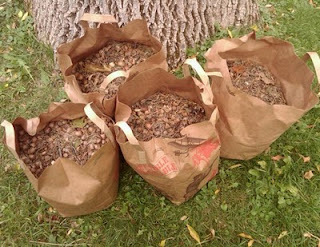 Four grocery bags full of northern red oak acorns and assorted grass, twigs and, of course, weevil larvae. So the trick is to get from that to this...
 ... as quickly and easily as possible. Because I love acorns and believe they can, quite literally, save the world - but I hate, hate, hate food preparation in any form. So if I can do it, anyone can!
So that means we have to lose the grass, twigs, acorn caps and at least some of the weevils (protein). Then we need to shell, leach the tannins, dry and grind. All that is no problem. It just takes a high threshold for boredom and a little ingenuity. I have one out of the two.
It's the baking part the scares me. More to the point it's the baking part that scares my family.
I'm experimenting with 2 methods for sorting acorns from other life forms this afternoon. Stay tuned for updates...


So that means we have to lose the grass, twigs, acorn caps and at least some of the weevils (protein). Then we need to shell, leach the tannins, dry and grind. All that is no problem. It just takes a high threshold for boredom and a little ingenuity. I have one out of the two.
It's the baking part the scares me. More to the point it's the baking part that scares my family.
I'm experimenting with 2 methods for sorting acorns from other life forms this afternoon. Stay tuned for updates...
Friday, August 20, 2010
Acorns Poisonous?
Good grief.
The columnist, a gentleman named Bill Hayes, appears to work at the Master Gardener Office of Aiken County South Carolina Extension Service. He was asked if acorns are poisonous. He decided to make the question the subject of his column in the Aiken Standard.
He spends most of the time confusing the concepts of bitterness and toxicity. He spends the rest of them time equating acorn diets with a short lifespan and reduced population numbers.
One gem: "I found all sorts of stories about Native Americans eating acorns as part of their daily diet. I also found one article that said that the average life span of the American Indian was 30 years but made no reference to acorns as being part of the problem." For Pete's sake. For starters we don't really have any clue what the average life span of Native Americans was pre-European settlement. Post colonization there were minor issues like disease epidemics that tended to limit life span.
If you leach acorns they are perfectly tasty, and incredibly nutritious. Native Americans knew how to leach, process and store acorns in a way that rendered them edible decades later when settlers uncovered abandoned caches. Acorns have extremely high food value. It defies reason to suggest they might somehow shorten lifespan. Lots of other things faced by indigenous people would conspire to shorten lifespan: The vagaries of weather, the dangers of hunting, warfare, and again and most importantly devastating diseases brought by Europeans. Acorns were not one of those things.
Another doozy: "I finally located an article about squirrels and acorns. It turns out that gray squirrels have an enzyme in their system that protects them from the effects of red acorns. It doesn't change the taste, which is very bitter, but it does prevent a toxic reaction in the stomach. Most squirrels in Aiken are gray but we do have a few red ones too. Red squirrels are not as lucky as the grey and have no protection against the toxins in red acorns. Maybe that's why we have so few red squirrels."
First of all gray squirrels (and blue jays) cache acorns in a way that allows rainwater to percolate and leach the tannins for them... which apparently makes them smarter than many people I can name (and their remarkable ability to find the acorns they cached the previous autumn always amazes me, a guy who can't find my own car at the mall). Secondly red squirrels don't have the enzyme that helps break down tannins primarily because they eat other plant seeds, mushrooms, etc. Or perhaps they eat those foods because they lack the enzyme. Chicken, egg. The point is that their evolutionary niche is different from gray squirrels, so I doubt red squirrels shed a lot of tears over their inability to digest acorns.
Speaking of evolution, yes there are some kinds of livestock for whom acorns can be toxic, such as cattle and horses. Meanwhile, hogs + acorns = tasty. Can we put on our Darwin caps and figure out why that might be? Perhaps the difference between domestic animals who are meant to graze on grasses and forbes (and not, incidentally, feedlot corn) and domestic animals descended from woodland dwellers?
I know that mostly Mr. Hayes was trying to write a fun, light-hearted column with some interesting factoids meant to entertain readers, and there is some valuable information. But look, we are talking here about a food crop that sustained humankind for millenia, and that has the potential to feed millions and heal a damaged planet. Let's not make jokes about acorns shortening life spans, OK?
Toxic? Have you seen what's in most of the food we eat??
Thanks.
The columnist, a gentleman named Bill Hayes, appears to work at the Master Gardener Office of Aiken County South Carolina Extension Service. He was asked if acorns are poisonous. He decided to make the question the subject of his column in the Aiken Standard.
He spends most of the time confusing the concepts of bitterness and toxicity. He spends the rest of them time equating acorn diets with a short lifespan and reduced population numbers.
One gem: "I found all sorts of stories about Native Americans eating acorns as part of their daily diet. I also found one article that said that the average life span of the American Indian was 30 years but made no reference to acorns as being part of the problem." For Pete's sake. For starters we don't really have any clue what the average life span of Native Americans was pre-European settlement. Post colonization there were minor issues like disease epidemics that tended to limit life span.
If you leach acorns they are perfectly tasty, and incredibly nutritious. Native Americans knew how to leach, process and store acorns in a way that rendered them edible decades later when settlers uncovered abandoned caches. Acorns have extremely high food value. It defies reason to suggest they might somehow shorten lifespan. Lots of other things faced by indigenous people would conspire to shorten lifespan: The vagaries of weather, the dangers of hunting, warfare, and again and most importantly devastating diseases brought by Europeans. Acorns were not one of those things.
Another doozy: "I finally located an article about squirrels and acorns. It turns out that gray squirrels have an enzyme in their system that protects them from the effects of red acorns. It doesn't change the taste, which is very bitter, but it does prevent a toxic reaction in the stomach. Most squirrels in Aiken are gray but we do have a few red ones too. Red squirrels are not as lucky as the grey and have no protection against the toxins in red acorns. Maybe that's why we have so few red squirrels."
First of all gray squirrels (and blue jays) cache acorns in a way that allows rainwater to percolate and leach the tannins for them... which apparently makes them smarter than many people I can name (and their remarkable ability to find the acorns they cached the previous autumn always amazes me, a guy who can't find my own car at the mall). Secondly red squirrels don't have the enzyme that helps break down tannins primarily because they eat other plant seeds, mushrooms, etc. Or perhaps they eat those foods because they lack the enzyme. Chicken, egg. The point is that their evolutionary niche is different from gray squirrels, so I doubt red squirrels shed a lot of tears over their inability to digest acorns.
Speaking of evolution, yes there are some kinds of livestock for whom acorns can be toxic, such as cattle and horses. Meanwhile, hogs + acorns = tasty. Can we put on our Darwin caps and figure out why that might be? Perhaps the difference between domestic animals who are meant to graze on grasses and forbes (and not, incidentally, feedlot corn) and domestic animals descended from woodland dwellers?
I know that mostly Mr. Hayes was trying to write a fun, light-hearted column with some interesting factoids meant to entertain readers, and there is some valuable information. But look, we are talking here about a food crop that sustained humankind for millenia, and that has the potential to feed millions and heal a damaged planet. Let's not make jokes about acorns shortening life spans, OK?
Toxic? Have you seen what's in most of the food we eat??
Thanks.
Monday, August 9, 2010
Oak Nirvana
I just got back from Oak Nirvana. A place with staggering diversity of oak "species." A place where there's so much natural hybridization that it renders laughable the concept of species when applied to the genus Quercus (frequent readers know that I contend that there are perhaps two true "species" of oaks with hundreds of interbreeding variations in constant transition and evolution). A place that literally makes my head spin with the possibilities and potential for going back in time to our acorn eating Eden. A place where the word dirt is spoken with the reverence it deserves.
Stay tuned.
Stay tuned.
Friday, August 6, 2010
Happiness is... Absolutely Brilliant Readers!
I've been exploring - in a very intermittant and extremely haphazard sort of way - the question of why humankind "evolved," or more accurately transitioned, from living a life of relative leisure and plenty living on the "fruit" of trees - acorns - to living a life of toil and sweat waging war on the soil to grow grains.
Commenting on my most recent post on the subject reader "Eric The Red" wrote:
... consider these aphorisms. The way to a man's heart is through his stomach. An army marches on its stomach. The bible stating that man must support himself by the sweat on his brow. Control what a culture eats (and how much free time the culture has) and you control what that culture does.
Brilliant stuff, encapsulating in a few short sentences what I've been struggling with across months and rambling paragraphs.
Control. I have to think that the concept of control - over land, over food, and therefore over populations - has a lot to do with the transition from living off the bounty of trees to the sweat, oil and blood-soaked battle with the land.
Yes, traditional balanocultures had a tradition of "ownership" to some degree. In California's balanocultures, which survived into the 19th and even early 20th centruries (and which, I should thankfully add, still survive today as a culture but not with the same freedom of movement or control over the land) family would lean a decorative stick against the trunk of a particular oak tree to claim ownership of that year's acorn crop. A family hoping to share in that tree's bounty would then need to negotiate for the right to a share of that tree's crop, and provide payment of some kind.
But this is a very different concept than the kind of land ownership necessitated by and made possible by production of annual grain crops.
Dr. David Bainbridge writes that California balanocultures could gather enough food to last a year in just a few weeks of labor. Of course there would be continual labor involved in processing (leaching and grinding) and cooking the acorns to eat, but this work would be done with the reassuring knowledge that a year's food - or two years' food - is cached and safe. The amount of leisure time must have been astounding! Astounding... and a real threat to anyone hoping to control a population's activities. Far easier and far better to have those people (and by "people" I mean men who a) must have had immense amounts of leisure time in balanocultures and b) would be the people rulers would most want to control for their own military purposes) staring at the back end of a beast of burden while fighting to keep the plow straight. Far easier to own and control the land, and get others to work it in exchange for a very small portion of the crop. Far easier to keep others in a permanent state of indebtedness.
It's a system we all bought into, and buy into every day in a hundred small, almost unnoticeable ways.
I've been obsessed with the question of why we changed, why we stopped eating acorns. Greed, control, guilt, wanderlust. I'll keep thinking about and writing about this question of why.
But the new question I'll be spending a lot more time thinking about, writing about, and hopefully living out is: How do we go back?
Commenting on my most recent post on the subject reader "Eric The Red" wrote:
... consider these aphorisms. The way to a man's heart is through his stomach. An army marches on its stomach. The bible stating that man must support himself by the sweat on his brow. Control what a culture eats (and how much free time the culture has) and you control what that culture does.
Brilliant stuff, encapsulating in a few short sentences what I've been struggling with across months and rambling paragraphs.
Control. I have to think that the concept of control - over land, over food, and therefore over populations - has a lot to do with the transition from living off the bounty of trees to the sweat, oil and blood-soaked battle with the land.
Yes, traditional balanocultures had a tradition of "ownership" to some degree. In California's balanocultures, which survived into the 19th and even early 20th centruries (and which, I should thankfully add, still survive today as a culture but not with the same freedom of movement or control over the land) family would lean a decorative stick against the trunk of a particular oak tree to claim ownership of that year's acorn crop. A family hoping to share in that tree's bounty would then need to negotiate for the right to a share of that tree's crop, and provide payment of some kind.
But this is a very different concept than the kind of land ownership necessitated by and made possible by production of annual grain crops.
Dr. David Bainbridge writes that California balanocultures could gather enough food to last a year in just a few weeks of labor. Of course there would be continual labor involved in processing (leaching and grinding) and cooking the acorns to eat, but this work would be done with the reassuring knowledge that a year's food - or two years' food - is cached and safe. The amount of leisure time must have been astounding! Astounding... and a real threat to anyone hoping to control a population's activities. Far easier and far better to have those people (and by "people" I mean men who a) must have had immense amounts of leisure time in balanocultures and b) would be the people rulers would most want to control for their own military purposes) staring at the back end of a beast of burden while fighting to keep the plow straight. Far easier to own and control the land, and get others to work it in exchange for a very small portion of the crop. Far easier to keep others in a permanent state of indebtedness.
It's a system we all bought into, and buy into every day in a hundred small, almost unnoticeable ways.
I've been obsessed with the question of why we changed, why we stopped eating acorns. Greed, control, guilt, wanderlust. I'll keep thinking about and writing about this question of why.
But the new question I'll be spending a lot more time thinking about, writing about, and hopefully living out is: How do we go back?
Thursday, July 8, 2010
Paradise Lost - Stupidity?
"Stupid is as stupid does"
~Forrest Gump's mother
"The stupidest man on Earth
is the man who thinks he's smarter
than everyone else"
~Anonymous*
I have been thinking a lot about stupidity. (I'm sorry, but I really like that sentence.)
Last week I was going to pick up the theme I have been wrestling with for some time: For millennia humankind lived a nearly Utopian life among food-bearing trees, both in creation myth and in reality. Biblical man was cast out of paradise by a fall from grace. Perhaps that is truly what happened. But my secular mind has been searching for a deeper answer to a question that is at once simple and endlessly complex: Why? Why did we did we stop living a life of leisure, happiness and peace harvesting & eating tree crops - which in many areas that meant primarily acorns - and switch to a life of toil and sweat producing and eating annual grain crops? (Incidentally, we made the same bone-headed decision on behalf of our livestock as well. Originally we both ate acorns. And when we started cultivating grains we actually first fed them to our livestock, keeping the acorns for ourselves. Only later did we decide to do battle with millions of square miles of the Earth’s surface to produce grains for us both.)
Various sources discuss overpopulation and competition for resources, overuse of the resource (the arboreal equivalent of the Pleistocene overkill theory), or, as William Bryant Logan convincingly argues in Oak: The Frame of Civilization, wanderlust and boredom.
Well, like I said I was getting ready last week to explore these theories when events conspired both to delay my writing but also to bring me face to face with an entirely new theory I hadn't considered: Stupidity. People can be remarkably, mind-blowingly stupid.
Let's first talk about the different kinds of stupidity, and then explore how these different flavors of stupidity might have caused us to leave our cushy happy life eating the fruits of the trees and spend our days instead in endless toil, at war with soil, and in love with oil (Nobel Prize for poetry here I come!). Much of what is viewed as "human nature" (oxymoron?) is meant to get us through the day and, more to the point, get us collectively and me individually regenerated in a new generation. Many of these same traits result in actions that are, over the passage of time, stupid, pointless and self-destructive.
1. Arrogance/hubris - Believing that you are smarter than everyone else, and smarter than nature.
2. Enviousness - Believing that the "other" is always "better" - it's better over there over that hill, the grass is always greener, etc.
3. Pride (variation on hubris) - Believing that others are lazy compared to you
4. Self-centered-ness - Believing that every idea you have is new and unique in the universe (instead of a repeat of ideas had millions of times before in minds brighter than yours)
5. Need for control - Believing that by controlling resources you can therefore control people, and their hopes, dreams and aspirations
OK, this is getting repetitive, but you get the point. Given all of these human failings, all of this collective stupidity, it was inevitable that we would leave our happy peaceful life among the trees and acorns to come down into the valley and pound on the soil. What is perhaps more remarkable is that there were any people who didn't give in to stupidity and who didn't leave the trees until forced to (the indigenous people of California, Oregon and parts of Washington for example). Would they have walked away from their life of happiness and plenty given enough time? I'd like to think not, but what I believe about human nature tells me they would have.
We are hard-wired to not just hang out, relax and let nature provide in the way it always has and always will. We need control. We need to feel like we are in control of our food supply. And a small number of us need to feel like we are in control of others. The easy abundance of an acorn-based society does not allow a small number of people to control resources in the way that a grain based culture does.
We need to do things differently than they were done before - or at least believe that we are doing things differently than before.
We seem to need to believe not only that we must do battle with the Earth for sustenance, but even more remarkably we seem to believe that we can win that battle. Duh.
I better stop now or this will never get posted. But we’ll keep exploring the question of Why? in future posts. It is no doubt a combination of things – overpopulation and overuse of resources in some areas, boredom and wanderlust in others, dispersal by war and force in others – but I now have no doubt that underpinning any and all of these is the simple, sadly inevitable and infinitely repeated – fact of human stupidity.
They say that the first step to recovery is admitting you have a problem. We need to collectively and individually realize how stupid we have been in walking away from tree crops in favor of grains. Only then can we begin to change and regain the paradise that we lost.
And most of all: Never, ever let stupidity get in the way of the life you’re intended to live.
Apropos nothing.
* OK, that wasn't anonymous. I'm the one who said that.
~Forrest Gump's mother
"The stupidest man on Earth
is the man who thinks he's smarter
than everyone else"
~Anonymous*
I have been thinking a lot about stupidity. (I'm sorry, but I really like that sentence.)
Last week I was going to pick up the theme I have been wrestling with for some time: For millennia humankind lived a nearly Utopian life among food-bearing trees, both in creation myth and in reality. Biblical man was cast out of paradise by a fall from grace. Perhaps that is truly what happened. But my secular mind has been searching for a deeper answer to a question that is at once simple and endlessly complex: Why? Why did we did we stop living a life of leisure, happiness and peace harvesting & eating tree crops - which in many areas that meant primarily acorns - and switch to a life of toil and sweat producing and eating annual grain crops? (Incidentally, we made the same bone-headed decision on behalf of our livestock as well. Originally we both ate acorns. And when we started cultivating grains we actually first fed them to our livestock, keeping the acorns for ourselves. Only later did we decide to do battle with millions of square miles of the Earth’s surface to produce grains for us both.)
Various sources discuss overpopulation and competition for resources, overuse of the resource (the arboreal equivalent of the Pleistocene overkill theory), or, as William Bryant Logan convincingly argues in Oak: The Frame of Civilization, wanderlust and boredom.
Well, like I said I was getting ready last week to explore these theories when events conspired both to delay my writing but also to bring me face to face with an entirely new theory I hadn't considered: Stupidity. People can be remarkably, mind-blowingly stupid.
Let's first talk about the different kinds of stupidity, and then explore how these different flavors of stupidity might have caused us to leave our cushy happy life eating the fruits of the trees and spend our days instead in endless toil, at war with soil, and in love with oil (Nobel Prize for poetry here I come!). Much of what is viewed as "human nature" (oxymoron?) is meant to get us through the day and, more to the point, get us collectively and me individually regenerated in a new generation. Many of these same traits result in actions that are, over the passage of time, stupid, pointless and self-destructive.
1. Arrogance/hubris - Believing that you are smarter than everyone else, and smarter than nature.
2. Enviousness - Believing that the "other" is always "better" - it's better over there over that hill, the grass is always greener, etc.
3. Pride (variation on hubris) - Believing that others are lazy compared to you
4. Self-centered-ness - Believing that every idea you have is new and unique in the universe (instead of a repeat of ideas had millions of times before in minds brighter than yours)
5. Need for control - Believing that by controlling resources you can therefore control people, and their hopes, dreams and aspirations
OK, this is getting repetitive, but you get the point. Given all of these human failings, all of this collective stupidity, it was inevitable that we would leave our happy peaceful life among the trees and acorns to come down into the valley and pound on the soil. What is perhaps more remarkable is that there were any people who didn't give in to stupidity and who didn't leave the trees until forced to (the indigenous people of California, Oregon and parts of Washington for example). Would they have walked away from their life of happiness and plenty given enough time? I'd like to think not, but what I believe about human nature tells me they would have.
We are hard-wired to not just hang out, relax and let nature provide in the way it always has and always will. We need control. We need to feel like we are in control of our food supply. And a small number of us need to feel like we are in control of others. The easy abundance of an acorn-based society does not allow a small number of people to control resources in the way that a grain based culture does.
We need to do things differently than they were done before - or at least believe that we are doing things differently than before.
We seem to need to believe not only that we must do battle with the Earth for sustenance, but even more remarkably we seem to believe that we can win that battle. Duh.
I better stop now or this will never get posted. But we’ll keep exploring the question of Why? in future posts. It is no doubt a combination of things – overpopulation and overuse of resources in some areas, boredom and wanderlust in others, dispersal by war and force in others – but I now have no doubt that underpinning any and all of these is the simple, sadly inevitable and infinitely repeated – fact of human stupidity.
They say that the first step to recovery is admitting you have a problem. We need to collectively and individually realize how stupid we have been in walking away from tree crops in favor of grains. Only then can we begin to change and regain the paradise that we lost.
And most of all: Never, ever let stupidity get in the way of the life you’re intended to live.
Apropos nothing.
* OK, that wasn't anonymous. I'm the one who said that.
Tuesday, June 22, 2010
California Dreamin'
I was just in California.
When not crusading to go "back to the future" and establish a modern balanoculture (culture of acorn eating) I sell horticultural and forestry growing supplies. Always have, always will. Coming up with ways to grow things better and help plants overcome the unique stresses they face in a modern world of uncertain climate, increased deer damage, and a plethora of exotic and invasive weeds and insects is what I do. It's in my blood.
The trip was fantastic in two respects. First it was a great reminder that even in these difficult times there is opportunity everywhere if you look hard enough (and many times even if you don't).
The second was to see the oak-dotted hillsides (with the grass dried to its summer golden brown) with new eyes, the eyes of a balanophage. It was in California among its many indigenous cultures that acorn eating survived the longest, well into the 20th century as common practice and to the present among those who are working so hard to preserve their traditional way of life.
I love the work I do in the vineyard & orchard industries, and the endless creativity and drive to do things better and more efficiently on the part of the farm managers I call on. But driving through California I see constant reminders that this industry is an artificial construct, the happy but temporary and ultimately unsustainable marriage of virtually unlimited sunlight and extremely limited irrigation. Turn off the water and within months you're back to desert with just the skeletons of grapevines or almond trees.
I see the fuel that goes into growing these crops, and the unbelievably hard work that it takes. I have immense respect for anyone who makes his or her living by growing crops.
But when I see the oaks on the hillsides of California I see both the past and what I hope will be the future. These oaks were actively tended by the Native Americans who relied on them for a large part of their diet, but since those oaks evolved to grow there they didn't require much work - just occasional burning to reduce competition and make acorns easier to gather come autumn. These oaks supported a very large population - a pre-European contact population that was, by all accounts, extremely healthy and well fed, and a population that could gather a huge percentage of its caloric and nutrients needs for the entire year in a few short weeks of work.
... and yet everyone I know in the horticulture industry works extremely hard and is constantly complaining that they never have enough time to do enough fishing or just plain relaxing.
The answer is right there, on those golden hillsides.
And if I could get me cell phone camera to talk to my email I'd have pictures to show you... I'll work on that tomorrow.
UPDATE: Here's one photo of an oak-dotted Central California hillside. Makes me hungry. Makes me long for a simpler life.

When not crusading to go "back to the future" and establish a modern balanoculture (culture of acorn eating) I sell horticultural and forestry growing supplies. Always have, always will. Coming up with ways to grow things better and help plants overcome the unique stresses they face in a modern world of uncertain climate, increased deer damage, and a plethora of exotic and invasive weeds and insects is what I do. It's in my blood.
The trip was fantastic in two respects. First it was a great reminder that even in these difficult times there is opportunity everywhere if you look hard enough (and many times even if you don't).
The second was to see the oak-dotted hillsides (with the grass dried to its summer golden brown) with new eyes, the eyes of a balanophage. It was in California among its many indigenous cultures that acorn eating survived the longest, well into the 20th century as common practice and to the present among those who are working so hard to preserve their traditional way of life.
I love the work I do in the vineyard & orchard industries, and the endless creativity and drive to do things better and more efficiently on the part of the farm managers I call on. But driving through California I see constant reminders that this industry is an artificial construct, the happy but temporary and ultimately unsustainable marriage of virtually unlimited sunlight and extremely limited irrigation. Turn off the water and within months you're back to desert with just the skeletons of grapevines or almond trees.
I see the fuel that goes into growing these crops, and the unbelievably hard work that it takes. I have immense respect for anyone who makes his or her living by growing crops.
But when I see the oaks on the hillsides of California I see both the past and what I hope will be the future. These oaks were actively tended by the Native Americans who relied on them for a large part of their diet, but since those oaks evolved to grow there they didn't require much work - just occasional burning to reduce competition and make acorns easier to gather come autumn. These oaks supported a very large population - a pre-European contact population that was, by all accounts, extremely healthy and well fed, and a population that could gather a huge percentage of its caloric and nutrients needs for the entire year in a few short weeks of work.
... and yet everyone I know in the horticulture industry works extremely hard and is constantly complaining that they never have enough time to do enough fishing or just plain relaxing.
The answer is right there, on those golden hillsides.
And if I could get me cell phone camera to talk to my email I'd have pictures to show you... I'll work on that tomorrow.
UPDATE: Here's one photo of an oak-dotted Central California hillside. Makes me hungry. Makes me long for a simpler life.

Tuesday, June 8, 2010
Acorn Bread Forecast...
Getting a little ambitious later this week... I'll be attempting acorn bread for the first time.
Actually, bread is one thing I know how to do. Our kids have become total "bread snobs" and refuse to eat store bought bread except under extreme duress. At ages 11 and 8 they are dedicated label readers (my daughter actually knows what TBHQ stands for and can spell it... and of course remind me that it's the same thing as lighter fluid). "Look at all the chemicals in this bread, Papa! Ewww, how can you eat it?"
I was raised on Wonder Bread and I turned out... um... well, now that you mention it I see their point!
I have become the "DK" of the house: Designated Kneader. I'll be putting my hard-earned kneading skills to work making some acorn bread.
Next week we'll get even more adventurous, making a Korean acorn jelly called dotori muk from acorn starch. Food channel, here we come!
Actually, bread is one thing I know how to do. Our kids have become total "bread snobs" and refuse to eat store bought bread except under extreme duress. At ages 11 and 8 they are dedicated label readers (my daughter actually knows what TBHQ stands for and can spell it... and of course remind me that it's the same thing as lighter fluid). "Look at all the chemicals in this bread, Papa! Ewww, how can you eat it?"
I was raised on Wonder Bread and I turned out... um... well, now that you mention it I see their point!
I have become the "DK" of the house: Designated Kneader. I'll be putting my hard-earned kneading skills to work making some acorn bread.
Next week we'll get even more adventurous, making a Korean acorn jelly called dotori muk from acorn starch. Food channel, here we come!
Paradise Lost
Correspondent and friend of Oak Watch David Olsen emailed a wonderful article to me, "The Agriculture Of The Garden Of Eden" by J. Russell Smith (more famously author of Tree Crops, A Permanent Agriculture and hero of this blog).
My own thinking has been returning again and again to the concept of a "paradise lost;" a time when humankind was nourished largely by tree crops, and particularly by acorns. There is plenty of archaeological evidence of this: Mortars and pestles found at sites that pre-date The Age Of Grains (What were they grinding? Acorn flour!), evidence that even once people began growing grains these were primarily used as animal fodder while humans continued to eat acorns.
And, by all indications, these acorn-eating cultures - these balanocultures - were among the most prosperous cultures the world has known. To paraphrase Dire Straits, they got their protein for nothing and their fat for free - or close to it.
Of course, as I'm finding so often, no sooner do I think something than I find out that J. Russell Smith a) thought of it long before I did, b) brought greater clarity of thought to the idea, and c) expressed it more eloquently than I ever could.
Paradise lost? Smith goes back to the original paradise lost, Eden, to explore the idea of a time when humankind lived largely on tree crops rather than working themselves and soil to death growing annual grain crops:
The story of the Garden of Eden has been extrensively used by those who would influence human action. But strange to say, one of its most evident lessons appears to have been overlooked. It is for the farmer (emphasis mine) that the well-known drama has the plainest teaching of all. The race has been subjected to needless toil because the agriculturist has left this part of the Scripture entirely to the theologians... we can agree that the agriculture of the Garden was good, because it supported the race comfortably and without labor... The inhabitants of the Garden of Eden plainly lived without toil. They were born to that leisure for which we strive fiercely in this work-a-day world. So far as man was concerned, the sting of the expulsion was the fact that he had to go forth and eat bread in the sweat of his face... The offender... was driven forth from the Garden that was full of trees. The trees had made it Paradise.
I'd love to simply reprint the whole article here. I have already probably overstepped the bounds of "fair use" by quoting this much directly from the text, but a) it's too brilliant not to do so, and b) my goal here is not to claim credit for Smith's brilliance but to make it known to a wider audience.
J. Russell Smith was decades ahead of his time. Sometimes the cost of being that far ahead in your thinking is to be forgotten by the time your ideas finally occur to lesser minds like mine and become a reality.
More from the Garden of Eden coming soon...
My own thinking has been returning again and again to the concept of a "paradise lost;" a time when humankind was nourished largely by tree crops, and particularly by acorns. There is plenty of archaeological evidence of this: Mortars and pestles found at sites that pre-date The Age Of Grains (What were they grinding? Acorn flour!), evidence that even once people began growing grains these were primarily used as animal fodder while humans continued to eat acorns.
And, by all indications, these acorn-eating cultures - these balanocultures - were among the most prosperous cultures the world has known. To paraphrase Dire Straits, they got their protein for nothing and their fat for free - or close to it.
Of course, as I'm finding so often, no sooner do I think something than I find out that J. Russell Smith a) thought of it long before I did, b) brought greater clarity of thought to the idea, and c) expressed it more eloquently than I ever could.
Paradise lost? Smith goes back to the original paradise lost, Eden, to explore the idea of a time when humankind lived largely on tree crops rather than working themselves and soil to death growing annual grain crops:
The story of the Garden of Eden has been extrensively used by those who would influence human action. But strange to say, one of its most evident lessons appears to have been overlooked. It is for the farmer (emphasis mine) that the well-known drama has the plainest teaching of all. The race has been subjected to needless toil because the agriculturist has left this part of the Scripture entirely to the theologians... we can agree that the agriculture of the Garden was good, because it supported the race comfortably and without labor... The inhabitants of the Garden of Eden plainly lived without toil. They were born to that leisure for which we strive fiercely in this work-a-day world. So far as man was concerned, the sting of the expulsion was the fact that he had to go forth and eat bread in the sweat of his face... The offender... was driven forth from the Garden that was full of trees. The trees had made it Paradise.
I'd love to simply reprint the whole article here. I have already probably overstepped the bounds of "fair use" by quoting this much directly from the text, but a) it's too brilliant not to do so, and b) my goal here is not to claim credit for Smith's brilliance but to make it known to a wider audience.
J. Russell Smith was decades ahead of his time. Sometimes the cost of being that far ahead in your thinking is to be forgotten by the time your ideas finally occur to lesser minds like mine and become a reality.
More from the Garden of Eden coming soon...
Thursday, June 3, 2010
Cookies Devoured...
... and deemed delicious! We made acorn cookies last night, this time with commercially available Korean acorn flour (if having a friend purchase the flour in an Asian market in California and mailing it to Minnesota can be termed "commercially available").
I substitued agave for the pure maple syrup I used in a previous batch of acorn cookies. Here's the recipe we used:
Preheat to 350 for 15 minutes
1/2 cup butter (local organic)
1/2 cup agave
1/2 tsp vanilla extract
1/4 tsp almond extract
2 eggs (local farmer's market)
1/2 cup acorn flour
1-1/2 cup all purpose flour
1 tsp baking powder
Mix the dry ingredients in a bowl.
Melt the butter then add the agave. Add the rest of the wet ingredients to the butter/agave mixture.
Add the dry ingredients to the wet ingredients.
At this point I noticed a couple of things:
1. The resulting batter could easily double as a very effective construction adhesive - very sticky!
2. Like last time I tried this recipe, it need a little extra flour - about 1-1/2 tbs.
I dropped spoonfuls of batter onto a parchment paper lined air bake cookie sheet, and baked for about 13-15 minutes.
They turned out great! They have a much more "cake like" texture than the cookies I made last fall from acorn flour I ground myself, which makes sense because the Korean flour is extremely finely ground (just trying to measure a half cup results in a cloud of acorn flour dust!).
My son wanted to bring them to school for his teachers, so that's definitely a vote of approval.
In separate posts I'll discuss in more detail the acorn flour and acorn starch sent to me by Dr. David Bainbridge, and I'll look more in-depth at what these simple cookies can mean in the big scheme of things. Math might be involved.
I substitued agave for the pure maple syrup I used in a previous batch of acorn cookies. Here's the recipe we used:
Preheat to 350 for 15 minutes
1/2 cup butter (local organic)
1/2 cup agave
1/2 tsp vanilla extract
1/4 tsp almond extract
2 eggs (local farmer's market)
1/2 cup acorn flour
1-1/2 cup all purpose flour
1 tsp baking powder
Mix the dry ingredients in a bowl.
Melt the butter then add the agave. Add the rest of the wet ingredients to the butter/agave mixture.
Add the dry ingredients to the wet ingredients.
At this point I noticed a couple of things:
1. The resulting batter could easily double as a very effective construction adhesive - very sticky!
2. Like last time I tried this recipe, it need a little extra flour - about 1-1/2 tbs.
I dropped spoonfuls of batter onto a parchment paper lined air bake cookie sheet, and baked for about 13-15 minutes.
They turned out great! They have a much more "cake like" texture than the cookies I made last fall from acorn flour I ground myself, which makes sense because the Korean flour is extremely finely ground (just trying to measure a half cup results in a cloud of acorn flour dust!).
My son wanted to bring them to school for his teachers, so that's definitely a vote of approval.
In separate posts I'll discuss in more detail the acorn flour and acorn starch sent to me by Dr. David Bainbridge, and I'll look more in-depth at what these simple cookies can mean in the big scheme of things. Math might be involved.
Wednesday, May 26, 2010
Cookies Resumed...
After a fruitless search for acorn flour here in the Twin Cities area comes great news: a package with acorn flour and acorn starch is on the way from a friend, reader and oh, by the way, the world's foremost expert on balanoculture.
What culinary delights await? What kitchen disasters will result? Well with me in the kitchen we know two things for sure: 1) something's gonna get burnt - and it's not always the food, and 2) if a little butter is good, a lot of butter is better.
Julia Child I ain't... but if I can create delicious food from acorns, anyone can!
What culinary delights await? What kitchen disasters will result? Well with me in the kitchen we know two things for sure: 1) something's gonna get burnt - and it's not always the food, and 2) if a little butter is good, a lot of butter is better.
Julia Child I ain't... but if I can create delicious food from acorns, anyone can!
Monday, May 10, 2010
Acorns: Barbaric Food
From The Encyclopedia of Practical Cookery (published 1898, edited by Theodore Francis Garrett)...
At an early period of barbaric existence this fruit of the oak was ground into meal to make a kind of cake, or bread. In modern times it is regarded as food fit only for hogs, and even that is disputed. It is stated that in Germany acorns are sometimes chopped up and roasted to be used medicinally by invalids as coffee; by this process of roasting much of their intense astringency is destroyed.
Yes, acorns are highly questionable fodder for hogs as compared to the diet of most hogs today. Good grief, the world's best pork is acorn fed!
The best part: This encyclopedia entry started with...
Acorns (literally, oak (ac) corn)
Although we think of the word corn as being synonomous with maize, historically the word corn has had a much more general meaning of the edible seeds of plants.
So in other words, people down through history have called acorns "the edible seeds of oak trees," and then a writer in the "modern times" of 1898 decided that as food acorns might not even be fit for hogs.
At an early period of barbaric existence this fruit of the oak was ground into meal to make a kind of cake, or bread. In modern times it is regarded as food fit only for hogs, and even that is disputed. It is stated that in Germany acorns are sometimes chopped up and roasted to be used medicinally by invalids as coffee; by this process of roasting much of their intense astringency is destroyed.
Yes, acorns are highly questionable fodder for hogs as compared to the diet of most hogs today. Good grief, the world's best pork is acorn fed!
The best part: This encyclopedia entry started with...
Acorns (literally, oak (ac) corn)
Although we think of the word corn as being synonomous with maize, historically the word corn has had a much more general meaning of the edible seeds of plants.
So in other words, people down through history have called acorns "the edible seeds of oak trees," and then a writer in the "modern times" of 1898 decided that as food acorns might not even be fit for hogs.
Thursday, May 6, 2010
Oil and acorns
The previous post about acorn oil got me thinking about the "black gold" kind of oil, and the relationship between the two types.
When J Russell Smith wrote his classic, Tree Crops: A Permanent Agriculture he was primarily concerned about the loss of our precious soil as a result of producing annual grain crops. In the wake of the recent oil spill in the Gulf, he might have just as easily been talking about the loss of wetlands, estuaries, sea life, etc. as a result of our love affair with annual grain crops.
What's the connection? Producing corn and soybeans requires an immense input of fossil fuels (that's why ethanol as a gasoline alternative is so wrong-headed; it takes more energy to produce ethanol than is contained in the ethanol).
On the other hand, permanent woody crops such as acorns, chestnut and hazelnuts require a very low fossil fuel input - actually a very low input of "work" in general, which explains the popularity of bocce ball in the acorn- and chestnut-eating parts of the world.
So, to review what we know so far...
1. Acorn eating cultures have historically been affluent, peaceful... and well fed
2. Nut eating (and livestock foddering) cultures work less and relax more
3. An acorn based diet is incredibly nutritious
4. Switching from the annual battle with our topsoil known as grain production to a permanent woody agriculture would conserve soil and fossil fuels - reducing our depency on foreign sources (and the ethical conundrums that come along with that dependency) and reduce the risk of environmental disasters like the one we are seeing in the Gulf
Yes, it certainly is easy to see why we got away from balanoculture - eating acorns - isn't it?
I'm not sure whether to spend more time trying to understand how/why we ever stopped eating acorns, or trying to encourage people to return to it.
So I'll keep doing both.
When J Russell Smith wrote his classic, Tree Crops: A Permanent Agriculture he was primarily concerned about the loss of our precious soil as a result of producing annual grain crops. In the wake of the recent oil spill in the Gulf, he might have just as easily been talking about the loss of wetlands, estuaries, sea life, etc. as a result of our love affair with annual grain crops.
What's the connection? Producing corn and soybeans requires an immense input of fossil fuels (that's why ethanol as a gasoline alternative is so wrong-headed; it takes more energy to produce ethanol than is contained in the ethanol).
On the other hand, permanent woody crops such as acorns, chestnut and hazelnuts require a very low fossil fuel input - actually a very low input of "work" in general, which explains the popularity of bocce ball in the acorn- and chestnut-eating parts of the world.
So, to review what we know so far...
1. Acorn eating cultures have historically been affluent, peaceful... and well fed
2. Nut eating (and livestock foddering) cultures work less and relax more
3. An acorn based diet is incredibly nutritious
4. Switching from the annual battle with our topsoil known as grain production to a permanent woody agriculture would conserve soil and fossil fuels - reducing our depency on foreign sources (and the ethical conundrums that come along with that dependency) and reduce the risk of environmental disasters like the one we are seeing in the Gulf
Yes, it certainly is easy to see why we got away from balanoculture - eating acorns - isn't it?
I'm not sure whether to spend more time trying to understand how/why we ever stopped eating acorns, or trying to encourage people to return to it.
So I'll keep doing both.
Subscribe to:
Posts (Atom)