Showing posts with label Quercus agrifolia. Show all posts

Tuesday, April 16, 2013

Unproductive productivity

Last spring I was speaking with a customer for tree tubes, a guy I have known for years.  I hadn't spoken to him since we moved from Minnesota to California.  He asked where in California and I said the Central Coast, near San Luis Obispo.

"Oh yeah," he said, "I've been there many times."

"Really?" says I.

"Yes," he said, "every time I hired a new sales manager to cover that territory I had to fly out there two years later and fire him because he'd start spending all of his time hiking, surfing and fishing.  It's just too beautiful there to get any work done."

I can easily see how that could happen.  However, sadly - or perhaps happily - I have the opposite problem.  Since we moved here I have never been so busy, nor have I ever worked so many hours.  Customers won't let me slack off.  That and having three kids to get through college tends to be all the incentive I need to keep my (extremely large) nose to the ol' grindstone.  Surfing?  Cripes, as you have seen I don't even have time for blogging - an activity I enjoy more and which carries a 97.3% reduced risk of getting attacked by sharks.

No, any reduction in overall productivity I have at this time of year is due primarily to this:

(Click to enlarge)
And this:
(Click to enlarge)
And, finally, this:
(Click to enlarge)
Coast live oak (Quercus agrifolia) flowers, taken last week at a park in San Luis Obispo. To paraphrase my words at the time, "Ha-ha-ha...CHOOO!"  Yes, I am deathly allergic to oak pollen.  Ironic, no?

I tracked this small grove of oaks from flowering through acorn harvest last year.  I took this photo about this time last year (obviously a little later since the flowers were browning by then):
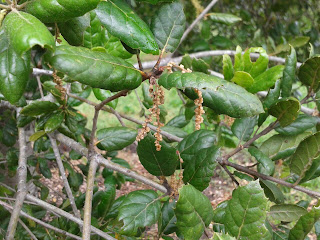

These small coast live oaks had what I'd call a moderate acorn crop last year.  In autumn every time we visited the park my then 2 year old son would want to pick some acorns and taste them... and then spit them out in disgust while shouting "Ewwwwy!"  It became a sort of ritual.

This year's blossom seems much more dense and verdant.  It will be cool to see how that translates into an acorn crop.  And it gives me about 5 months to teach my son how yummy acorns can be!

Meanwhile, as long as the oaks are blooming and my allergies are raging every burst of productivity from me takes seemingly three times the effort.

Stupid trees.


Tuesday, March 12, 2013

Promises, promises!

Thank you to the new folks following Oak Watch!  I'm sorry it's been so long since I have posted.  I am still in the middle of longest and largest (in terms of sheer volume) period of sustained business (busy-ness) I have ever known in the forestry and hort supply business that puts food on our (quarter sawn oak!) table, but the backlog of posts (at least inside my noggin) has grown to the point where I need to get back to writing.  My basic sanity demands it as well.

So lots of posts are coming soon, all long overdue:

The Good Samaritan of Grand Junction, CO

The Wizard of West Point

The Quercus Formerly Known As...

And more!

So I will firing up the Bic ballpoint (I can't compose at the keyboard and I still haven't gotten around to making oak gall ink - although that has now moved up into the #257 spot on the to-do list, putting its completion date at approximate two years after I retire.  And I expect retirement to come approximately 2 years after I die.)

In the meantime I will leave you with a few photos:  Pygmy coast live oaks (Quercus agrifolia) taken at the Elfin Forest in Los Osos - Baywood, CA.  These trees are twelve to fifteen feet tall.  They are several hundred years old.  A combination of cool temps, constant coastal fog and the fact they are growing in a soil-less sand dune approximately 3,000 ft deep have combined to stunt - bonsai - their growth.  Project number #592 on the to-do list is to grow acorns from these trees under better/warmer growing conditions and determine the degree to which their diminutive size is due to genetics versus environment - in other words is this truly a separate variety/sub-species, or simply garden variety live oak stunted by a lack of resources.

Enjoy, and see you soon!


Friday, June 1, 2012

My Cool Ride Home

A couple times per week business takes me from my Los Osos, CA home on the central coast to the San Joaquin Valley.  It's 2.5 hours but a whole world away.  The intensity and variety of agriculture in the valley never fails to amaze me (just add water).  But after a day standing in dusty fields talking to growers I'm always ready to hop in the truck and head home to the cool, foggy coast. 

Here is a summary of the latter part of my trip home yesterday, as it pertains to the native oaks of the area.

5:19pm
Passing through Shandon, CA 44 miles from home
97 degrees F
Native oaks are California white/valley oaks (Q. lobata) and California/coast live oak (Q. agrifolia), most growing as widely spaced medium sized trees on the grassy range land hillsides, growing bigger on the banks of the (mostly dry) creeks.

5:44pm
Passing through Atascadero, CA 22 miles from home
91 degrees F
Both California white and California live oaks, with the whites dominant.  As I have posted before this is where the combination of degree days and available water produce some real giants (that's my baseball cap against both trunks):


(Click to enlarge)


6:00pm
Hwy 41 at the top of the pass between Atascadero and Morro Bay
67 degrees F
This is almost precisely where the California white oaks disappear and the live oaks become the dominant - though increasingly stunted - species

6:02pm
Hwy 41
61 degrees F

6:04pm
Morro Bay, CA
58 degrees

6:10pm (and most importantly in time for the end of soccer season pizza party!)
Los Osos, CA
54 degrees w/fog
California live oaks dominate the coastal scrub.  Bonsai California live oaks.

Less than 1 hour, 44 miles, and a temperature drop of 43 degrees - right into my comfort zone (the farther it gets away from 60 degrees in either direction the crankier I get).

I'm not exactly breaking new ground here in pondering the effects of coast and topography on climate, but for someone recently transplanted from the Arctic tundra of Minnesota it's pretty darn fascinating.

Thursday, April 26, 2012

Prettier than any rose...

Took this at a park in San Luis Obispo this morning...


(Click to enlarge)

California (coast) live oak (Q. agrifolia) flowers, pollinated and ready to become acorns over the course of the summer.  I have mentioned that where I live near Morro Bay it is generally quite cool, with highs in the 60s pretty much year round, and thick morning and evening fogs, while just 20 miles inland at Atascadero or Paso Robles it gets colder in winter and cooks at 100+ in the summer.  In between is San Luis Obispo, just beyond the curtain of fog that so often shrouds the coast, but with enough coastal influence to keep from overheating.  In other words, just about perfect.

Which is why no one can afford to live there.

But back to the flowers.  To me this is what it's all about.  These inconspicuous flowers - so inconspicuous that 99.4% of the visitors to this park wouldn't even recognize them as such - are more beautiful in my eyes than any rose or lily.  Because to me - and to the Chumash people long before me - these flowers represent the promise of this:


Which reminds me of a little known fact.  Most American Indian tribal names mean "The People" in each given language.  In contrast Chumash, loosely translated, means "People of the dented skulls."

OK, I made that up.

I get to this park quite often.  I will be tracking the development of these acorns over the course of the summer.  And eating them in autumn.


Wednesday, April 25, 2012

Evening Oaks

(Click to enlarge)

I had to take this shot one evening last week on my way home after a day on the road.  Highway 41 just west of Creston, CA.  Hillside of California white (a.k.a. valley) oak (Q. lobata) and coast live oak (Q. agrifolia).  Lay a tarp under these trees in August/September and you'd eat like a king for a year!

I have been amazed at how late the California white oaks leaf out in this area.  As I have said there are no white oaks where I am on the coast; they start about 10 miles inland and up the hill.  Where the white oaks are there has been plenty of weather that Midwestern oaks would kill for - several 80 degree days.  Midwestern oaks, "knowing" that every degree day comes at a premium and is precious, leaf out as soon as it is remotely safe to do so.  But these white oaks are taking their time to leaf out.  Probably because they "know" (I should probably delete the quotation marks - oaks do know things, a lot more than us!) that degree days are not a problem.  Here on the coast it rarely breaks 70.  Go ten miles inland where the white oaks are and a month from now it will be pushing 100 or more.  Why rush things?

They are well adapted for the area.  I, apparently, am not.  I'm still the one softball parent wearing a t-shirt when everyone else is in parkas.  I might as well wear a neon sign that says, "Transplanted Northerner."

Monday, March 26, 2012

My NEW favorite oak tree

On Friday we hiked a trail along a creek near Los Osos, CA.  A couple miles out we encountered a mammoth & perfectly formed coast live oak (Q. agrifolia) that I decided to make my new favorite oak tree.  Then a couple of minutes later we saw one WAY more awesome than that one.  (I know, I know.  This is the 137th favorite oak tree I have mentioned on this site.  What's Chris's favorite oak tree? The last oak tree he saw.)

But this one is truly awesome.  Spectacular.  A colossus. This monster has branches that swoop down to the ground, go completely subterranean, then emerge again several feet later.  This tree nourished generations of people.  This tree... Did I mention I forgot my camera?

Doh.

Good excuse to take that hike again.  We went in search of wildflowers but blossoms are sparse this year due to a very dry "winter" (as a Minnesota native any reference to "winter" in coastal California will always have quotation marks noting the oxymoron).  I found something even better, and forgetting the camera gives me a good excuse to go see it again.

Tuesday, March 13, 2012

Atascadero Giants

(Click to enlarge)

I drive by this tree all the time - a California white oak a.k.a. valley oak (Q. lobata) - on my way to visit customers. Yes that's my baseball cap to show scale.  And even though I have a very large melon (both literally and figuratively)... that's still a stout tree.

Here's "the rest of the story..."
(Click to enlarge)

This giant has seen better days.  What a monster it must have been!  Imagine the generations of people and wildlife she fed and sustained!

Here's another one:
(Click to enlarge)
 
Found this one at a park while on a stroll between soccer tournament games last fall (yes that's how behind I am on posting).  Another California white oak.  I'm not sure how to measure dbh (diameter at breast height, the standard method foresters use for measuring girth) - immediately behind the tree is a (mostly dry) creek that drops down about 5ft.  Dbh on the creek side of the tree is at root level for the upper side.  To measure dbh of the upper side I'd need a step ladder when I get around to the creek side.

Any way you slice it, the diameter is more than 6 feet.  Heck, the branch has a diameter most oak trees would envy!  (It also has some serious cantilevering that Frank Lloyd Wright would envy... can you imagine what that branch weighs?)

I'm starting to "collect" these California white oak giants in a mental list while I'm out and about on sales calls.  It's fun because here in Los Osos, CA our coast live oaks (Q. agrifolia) - the only oak species you see until you go about 7.83 miles inland - come in three varieties:  Stunted, puny and wee.

That's because our weather comes in three varieties:  foggy, chilly and cool.  It rarely gets above 80 and generally doesn't get much above 70... and the warmer it is the foggier the mornings and evenings are.  Perfect for me since I'm allergic to heat, apparently not great for producing massive oak trees.  On a summer day when driving Hwy 41 from Morro Bay to Atascadero 5 miles could mean 30 degrees in temperature. What a difference that 30 degrees makes in oak growth!

Monday, October 10, 2011

Horizontal Giant Still Going Strong

My new favorite tree in the whole world:  Coast live oak (Quercus agrifolia), San Luis Obispo Cty, California:
(Click to enlarge)

Yes, it is still alive:

(Click to enlarge)

This dude tipped over a long time ago and not only tenaciously clings to life, but continues to thrive - geotropism be damned.

Foresters generally measure d.b.h. - diameter at breast height.  They don't normally need to do this while in the prone position.

I'd give a week's pay for an increment boring of this tree.

Thursday, October 6, 2011

Fool Proof Test of Acorn Ripeness

Today on my lunchtime hike through the coast live oak scrub in the hills behind my home I brilliantly developed a 100% accurate test to determine the moment coast live oak acorns are ripe.
Here's how you know they are ripe:  They are gone.

I have been watching green acorns for weeks, watching for the precise moment when they get ripe enough to pick to eat and/or plant.  I have discovered that there are precisely three types of coast live oak acorns:  Green ones, bug eaten ones, and empty acorn caps.

I might have to just stand next to a tree for a few days and fight off the jays and squirrels.  I don't mind; the view of Morro Bay from there is awesome.

Thursday, September 8, 2011

Blue Oak Sunrise

(Click to enlarge)

Sunrise on CA route 166.

The one of the left is blue oak, Quercus douglasii.  I think the one on the right is coast live oak (Q. agrifolia) but to know for sure I would have had to scale a barbed wire fence into a cattle holding pen.  I wasn't worried about getting hurt or trespassing; I was worried about what I'd step in on the way to a day of sales meetings ;-)

Wednesday, August 31, 2011

Rattlesnake Oaks

Nothing like a brisk jog through rattlesnake country to enliven the senses and quicken the pulse.  Yesterday I went running in the hills near our new neighborhood - I would say "where the sidewalk ends," but this is Los Osos and there aren't any sidewalks.  Or street lights.  Or sewers.  But that's another story for another day.

We have been told that rattlesnakes are prevalent in that area, and that this year they have been particularly active with several dogs getting bitten.  I couldn't resist the chance to explore what from a distance promised to be oak-rich hills, but I was definitely on high alert.

As I gained altitude (makes me sound like a condor when the shuffling pace of a tortoise with asthma is closer to the mark these days) I passed through low scrubby vegetation, into some taller (head high - or more accurately eyeball high - remind me to wear protective eye wear next time) scrubby stuff, then into some assorted low trees.  Stop me if this is getting too technical for you.

But that is essentially the level of my current knowledge of this area's vegetation and cover types.

I realized, much to my great joy and sadness, that I am in for new awakening, an epiphany of the sort I haven't felt in nearly 25 years.  That was when, as a student in forestry school, I spent a few weeks at the University of Minnesota's research center at Itasca State Park in northern Minnesota.  In just that short time, after intensive field classes in forest ecology, botany and soils, I came to view the forest with a whole new set of eyes.  I never looked at the woods in the same way again.

It's probably very similar to learning to read.  At some point as a very small child you become aware that those symbols on the page mean something, and you can recognize and name a few of them, but you have know idea how the whole system works, how those symbols fit together to tell a story.  Until you learn to read.  Then you can never see the printed page with those "old eyes" ever again.

There's something a bit sad about the process a well, and I have always felt a sense of loss, that the forest - at least the eastern hardwood forest and the northern boreal forest - for me no longer holds the same mystery and wonder for me that they used to.  And it was that sense of mystery and wonder that pushed me into forestry in the first place.  Bit of an irony, that.

I have always wanted to regain that sense of ignorant wonder - of not understanding, of not being able to read the forest like a book - in some new place.

But this isn't it.  All I could think about as I ran was:  I need to learn these plants, and how they fit together, and what story they tell.  I can't wait to put a name to them, to know them.  To see them with new eyes (assuming they don't get poked out by the brush first).  And to share what I learn with you.  Because the story these plant communities has to tell sustained some of the healthiest, happiest people on Earth for millennia.

OK, that's not ALL I could think about.  Mostly, if I'm being honest, I was thinking about rattlesnakes.  I lived in Tucson for three years, and used to run in a dry wash.  I saw rattlesnakes several times, but the wash was wide, sandy and barren so I could see them from some distance away.  The path I ran yesterday cuts a shoulder wide swath with head high "mini cliffs" on both sides of you, so you could come around a bend and be eyeball to eyeball with a rattler.  Not that the thought occurred to me at all.

My ascent ended in a grove of 20 foot tall California live oaks, all filled with green unripe acorns.  I'll be keeping a close on them as they ripen.  I will be gathering, growing and eating these acorns soon (and sending them to anyone who'd like to grow some).

Assuming the rattlesnakes don't get me first.