Living in the shadows of St. Olaf College like we do it's natural that our street is largely populated current and retired St. Olaf professors. The most colorful of these was Gordon Rasmussen, who sadly passed away a couple of years ago. One of a kind, Gordon was. He grew up in a tiny town in South Dakota speaking mostly Norwegian. He went on to master Latin, Greek and Hebrew and become a professor of religious studies.
The highlight of our Memorial Day Block Party was when Gordon would reminisce about his 50+ years on our street. He once said that when they got married his wife, Char, didn't want to have any children, "so we compromised and only had seven." Another time he told the story about how all the houses on the street were white and he wanted to paint his red. He painted every other tier of siding red, turning the house into a candy cane. He left it that way for most of the summer, and when he finally painted the whole house red all the neighbors were so relieved nobody was angry it wasn't white.
Another friend on the street is the swimming coach at St. Olaf (and college Hall of Fame inductee for his own swimming exploits while a student there). He told me that Gordon used to come to open lap swim wearing a huge fluorescent pink swimsuit, "So I'll be easier to see on the bottom of the pool."
He and his wife Char would take a slow walk up and down the street every afternoon. You could always tell Gordon was coming because he was preceded (depending on the wind) by a waft of cigar smoke. Our conversation was always the same; even though his brilliant mind getting wrapped in the haze of dementia he still had a ready joke.
"Hi Gordon, how are you doing?"
Dramatic pause, puff on cigar, and then he'd assume a serious expression.
"I can't answer that question. I'm Lutheran and we're not allowed to brag."
We all miss Gordon. I'd say "rest in peace," but I have a feeling resting in peace would bore him. So I'll say Rest in joy.
All of this is a long, but hopefully mildly entertaining, way of saying that if I list all of the things I'm thankful for at this time I'm afraid it will sound too much like bragging. But unlike Gordon, I'm going to do it anyway. Because I'm not Lutheran. Or Norwegian. Or remotely humble.
This has been a wonderful and remarkable year.
We had 2 children undergo surgery - neither serious and both highly successful
I made a change professionally that has led to the best and most successful year of my life.
I'm thankful for Alice, who fills my life with more grace and beauty and joy than anyone, especially me, deserves. I'm thankful for three amazing children, and especially this year for little Nicholas who proved it's never too late to join a family and multiply its happiness (even while minimizing its sleep ;-)
And I'm grateful for you, the folks who drop in and take time from busy lives to read the words I need to write, for allowing me to do what I got into forestry to do, and for crediting me with more and deeper meaning than I'm probably capable of.
Thank you. Best wishes one and all for a safe & happy Thanksgiving!
Wednesday, November 24, 2010

More People, More Trees
From ecological restoration, sustainability & balanoculture guru David Bainbridge:
http://practicalaction.org/video/view/morepeoplemoretrees/
Watch it. And rejoice.
BTW here's the scoop on the tree frequently mentioned, Grevillea robusta, silky oak. It's not really an oak, but we won't hold that against it.
http://practicalaction.org/video/view/morepeoplemoretrees/
Watch it. And rejoice.
BTW here's the scoop on the tree frequently mentioned, Grevillea robusta, silky oak. It's not really an oak, but we won't hold that against it.
Dotorimuk in NY Times
Some friends told me about this article http://www.nytimes.com/2010/10/13/dining/13acorn.html about dotorimuk, a traditional Korean acorn jelly.
From the article: "The truth is that homemade dotorimuk is more complicated than opening a box, but certainly easier than using the winnowing baskets of yore. And with acorns blanketing lawns across North America — including mine — a hyper-local dish was waiting right outside my door."
Hyper-local... I like it!
I have some acorn starch sent by another friend and have been meaning to make some dotorimuk. Regular readers know not to hold their breath when I promise to cook something because it rarely happens on schedule... but I will try to do it over this long weekend.
Acorns Revive Pilgrims
I'm farther along in reading Mayflower: A Story of Courage, Community, and War by Nathaniel Philbrick (which I highly recommend), and continuing to look for acorn references. It didn't take long.
After a harrowing first winter* during which more than half their number perished, the Pilgrims, with Squanto (who had previously been given a 6 year all-expenses paid tour of Europe... as a captive) acting as intermediary, struck an alliance of friendship with Massasoit, sachem of the Pokanoket people.
Later that summer Governor William Bradford dispatches Stephen Hopkins and Edward Winslow to travel with Squanto to visit Massasoit with the goal of strengthening friendship. Just a brief 40 mile two day hike. At noon of the second day the group stops for a quick lunch of herring and boiled acorns... the 17th century version of fast food! Except that this fast food won't kill you.
* Of course much of the reason that first winter was harrowing was that the Mayflower arrived in New England on November 11, 1620 just in time for winter. Remember that this was the "little ice age" with much harsher winters, and it snowed just a few days after they arrived (sounds like Minnesota where we've had snow on the ground since November 13). They had no shelter and were short of rations. Not a recipe for success. By spring 52 of the original 102 settlers would be dead.
The summer of 1620 went well. After getting off to a bad start by stealing corn from the local Indians' cache and looting one of their graves, the Pilgrims were able to achieve friendly relations with several local sachems. With Indian expertise and assistance they were able to grow a good crop of food, enough to see them through the winter ahead...
... until another ship arrives in November, 1621 with 37 more settlers sent by Mayflower "adventurer" (financier) Thomas Weston. Not only does Weston send 37 more mouths to feed and bodies to house just before winter, he doesn't send them with any additional provisions. Even better, the passengers carry a letter from Weston berating the Pilgrims for sending the Mayflower back the previous spring without enough saleable trade goods!
This time they send the ship back to England loaded with beaver pelts and other valuable goods. I would have included a letter saying, "Dear Tom, Sorry the return voyage of the Mayflower was light on trade goods. Providing a return on your investment must have slipped our minds, since the majority of us were busy dying. Your humble servant, William Bradford, Governor of Plymouth Plantation (because Carver is dead)"
Can't wait to see how they make it through the winter of 1621/22. All the sustenance they need had fallen from the oak and chestnut trees the month before. Stay tuned.
Tuesday, November 23, 2010
Place For Hybrid Oaks
Whenever I hear of or come across a source for hybrid oaks I want to highlight it. Rhora's Nut Tree Farm & Nursery offers a large selection of hybrid oaks. The descriptions lack the Latin names that an oak geek like me prefers to see, but most give the two parents. An exception is Sargent Oak, which is an English (Q. robur) X chestnut (Q. prinus) cross.
The descriptions provide a window into what is possible with hybrid oaks, and shatter the myth of the "slow growing oak." Even making an allowance for the hyperbole that oak enthusiasts in their zeal sometimes propagate, the growth and performance of these hybrid trees is staggering. Acorns in 4 years. Acorns in 4 years. Acorns in 5-8 years. 500 to 1000 lbs of acorns per tree. 800 to 1000 lbs of acorns per tree (that's 15+ bushels for those of you keeping score at home).
I know I have said this a million times, but... think of it! These trees are the result of a single selection and cross. The hybrid corn planted today is the culmination of 8000+ years of intensive selection, nearly 100 years of intensive hybridization (the primary goal of which is to produce patentable intellectual property that doesn't grow "true" from the seed it produces), and 20-30 years of genetic engineering.
Give me oaks with their willingness and ability to "hybridize" (and as always I use the term loosely since I don't believe we're actually crossing any true species boundary when we cross, say, white oak with bur oak), and give me 8000 years and by the end of that time I'll have them doing everything but singing show tunes. And that's only because I don't like show tunes.
In the meantime let's patronize the nurseries who are doing the yeoman's work of producing and selling hybrid oaks!
Acorns: How to trap a governor
I'm reading Mayflower: A Story of Courage, Community, and War by Nathaniel Philbrick - just in time for Thanksgiving (although the book is, of course, a complete debunking of the Thanksgiving story that was drilled into our heads as grade schoolers).
Me being me, I read any history of early settlement looking for references to reliance on acorns as a food source. In Mayflower acorns are conspicuous mostly by their absence (about which more below). The only reference to acorns so far is actually pretty hilarious. Shortly after landing at Plymouth Harbor a scouting parting is walking through the woods. They come across an ingenious snare set by the Indians. A sapling is bent over, and tied to the sapling is a rope lasso, the loop of which lays flat on the ground and encircles a pile of acorns - bait for deer. While those at the head of the column of Pilgrims are marveling at the ingenuity of the deer trap, William Bradford - soon to be named governor of Plymouth Plantation, a position he would hold for 35 years - blunders up, steps in the trap, and is promptly hoisted off the ground by his ankle... and earns the respect of the others (and of me) by good naturedly commenting on both the skill with which the trap was made and his own clumsiness in getting trapped.
The religious separatists who landed in Plymouth were by no means entering a untouched wilderness. The area had been, until very recently, home to thousands of people. The Pilgrims walked into the equivalent of an outdoor morgue; a plague, probably Bubonic Plague spread southward from European fishing settlements in Maine, had decimated the population in the years prior to the Pilgrim's arrival.
As a practical matter this meant that the Pilgrims were able to simply take over and plant fields that had been cleared by others. But what interested me was this: those fields, in which Native Americans had grown corn, squash and beans, were almost completely depleted of their nutrients and could only produce a decent crop with the addition of copious amounts of fertilizer - in this case fish.
I found it interesting that there, in the shadows of towering oaks and chestnut trees which rained down nutrition in the billions of tons, the indigenous people had over the course of centuries become more and more reliant upon crops that damage and deplete the land... land which once depleted would need to be replaced with other land cleared for the purpose of farming, a process which would inevitably create conflict between adjacent tribes or groups.
And so history repeats itself.
Friday, November 19, 2010
Valley Oak Leaves
Still catching up on the random photos I shot while traveling in California last week...

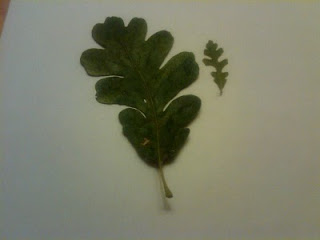
This valley oak leaf came from the fast growing (but poorly photographed) valley oak I mentioned in a previous post:

Planted as an acorn 5 growing seasons ago, now 20 feet tall. The leaf shown above was typical in size for this tree... which is to say tiny:


(Click to enlarge - but it will be blurry)
This valley oak leaf came from the fast growing (but poorly photographed) valley oak I mentioned in a previous post:

Planted as an acorn 5 growing seasons ago, now 20 feet tall. The leaf shown above was typical in size for this tree... which is to say tiny:

Adorable little thing isn't it? As you can see from the photograph above, the total leaf surface area of that young but fast growing valley oak is relatively small. You wouldn't think by looking at it that it would have the photosynthetic surface area necessary to fuel that kind of growth. But what these leaves lack in surface area they make up for in thickness; they are little power packs of energy.
As with all oak "species" (a term regular readers know that I use loosely since I view the entire oak genus as a single species with a continuum of traits, rather than as hundreds of species with thousands of hybrids), there is an enormous amount of variation in valley oak leaf size and morphology:

I collected the larger leaf from a valley oak just a few miles away (and yes, I still owe you the story behind that tree). Think those two fully developed, late-season leaves can't be from the same "species"? Think again.

Subscribe to:
Posts (Atom)