... because I get PAID to talk to awesomely cool people like a founder of the San Diego Sustainable Living Institute.
Keep your eyes on these folks. They will be doing - and growing - some incredible things in the years ahead.
Thursday, July 18, 2013

The Giants of Bialowieza Forest
Wow, the number of Oak Watch followers continues to grow despite my paltry output of late... thank you! Or, perhaps, the number of Oak Watch followers continues to grow because of my paltry output of late. Maybe if I stop writing altogether this will become the most read blog in the world!
Huge thank you to reader Walter for emailing a list of fascinating links. I will pass them along to you one or two at a time.
Travel to Poland, to be honest, has never been on my bucket list... until now. Click here to visit the amazing Bialowieza Forest. Incredible.
The oaks of Bialowieza - and we're talking about pedunculate/English/common oaks (Quercus robur) - are truly massive. Quoting from the web site:
In order to emphasize uniqueness of such trees the term CLASSICAL BIALOWIEZA OAK has been introduced. To bear this proud name an oak must meet the following criteria: the trunk's perimeter of such tree at the height of 130cm should be at least 550cm, the height of trunk up to the first branch should be at least 15 meters, the total trunk's height should exceed 25 meters and the tree's height should be at least 36 meters. While in the Forest there are thousands of oaks with monumental sizes, only 10-20 meet these criteria. I think that nowhere in Poland or even Europe there are such oaks like here, in the Bialowieza Forest.
For those of you keeping score at home 550cm in perimeter measured 130cm from the ground equates to about 5ft 8in in d.b.h. (diameter at breast height). Holy cats.
So take a break this afternoon or evening and travel to Bialowieza Forest, at least via pixels. The druid's Sistine Chapel.
Huge thank you to reader Walter for emailing a list of fascinating links. I will pass them along to you one or two at a time.
Travel to Poland, to be honest, has never been on my bucket list... until now. Click here to visit the amazing Bialowieza Forest. Incredible.
The oaks of Bialowieza - and we're talking about pedunculate/English/common oaks (Quercus robur) - are truly massive. Quoting from the web site:
In order to emphasize uniqueness of such trees the term CLASSICAL BIALOWIEZA OAK has been introduced. To bear this proud name an oak must meet the following criteria: the trunk's perimeter of such tree at the height of 130cm should be at least 550cm, the height of trunk up to the first branch should be at least 15 meters, the total trunk's height should exceed 25 meters and the tree's height should be at least 36 meters. While in the Forest there are thousands of oaks with monumental sizes, only 10-20 meet these criteria. I think that nowhere in Poland or even Europe there are such oaks like here, in the Bialowieza Forest.
For those of you keeping score at home 550cm in perimeter measured 130cm from the ground equates to about 5ft 8in in d.b.h. (diameter at breast height). Holy cats.
So take a break this afternoon or evening and travel to Bialowieza Forest, at least via pixels. The druid's Sistine Chapel.
Wednesday, June 26, 2013
How to kill an oak tree #973: Killing me slowly with backfill
God, this is disheartening. Stopped for gas in Paso Robles, CA on Friday afternoon (Paso Robles = Oak Tree Pass in English - the most recent and perhaps most ill-fitting language of the area) and I saw this:


(Click to enlarge)
This tree is dying. It is a massive California white oak/valley oak (Q. lobata) with a crown spread of about 80 feet or so.
And therein lies the problem. A crown spread of 80 feet equals a root system spread of more than 80 feet. But when the gas station was built the grade was raised around the tree, save for a 10 foot diameter dish right around the trunk that was left at the original grade.
The grade wasn't raised by much - 6 inches in most places, maybe 12 to 18 inches farther away from the tree. But that's enough, especially if (as I suspect) construction equipment compacted the soil in the drip line root zone. Roots that were inches below the surface poised to swallow precious moisture from the rare Paso Robles cloudbursts and which had plenty of pores of air space in which to breath, are now several times farther from the hard packed surface, with no air space to breath and no water to drink.
The sad parts are:
1. Someone actually made an effort to help the tree by leaving a dish at original grade. They just didn't know (I prefer that to thinking they knew and just didn't care) that the most valuable roots are way out below the drip line or beyond. They didn't know that even a minor change in grade, especially when combined with soil compaction, can suffocate the fine feeder roots that are the lifeblood of any tree, no matter how huge. The knowledge gap on construction sites is still, after all these years, immense.
2. The tree is dying so slowly - this gas station was built several years ago - that by the time it dies no one will connect its death to the damage that was done during construction. Instead its death will be blamed on old age (Ha! This tree would live another 150 years left to its own devices) or on the insect and/or disease pests that aren't the primary cause of death but are only the secondary and opportunistic beneficiaries of the tree's stress and struggles.
The third and saddest part?

3. There's another tree right next door behind a car dealership that is dying in exactly the same slow way.
Sigh.
Obey the drip line people. And if you're not going to - or can't - obey the drip line, then do the tree the honor of harvesting it and putting it to use, rather than leaving it to die a slow, drawn-out death that will leave its wood rotten and its spirit ruined.
2. The tree is dying so slowly - this gas station was built several years ago - that by the time it dies no one will connect its death to the damage that was done during construction. Instead its death will be blamed on old age (Ha! This tree would live another 150 years left to its own devices) or on the insect and/or disease pests that aren't the primary cause of death but are only the secondary and opportunistic beneficiaries of the tree's stress and struggles.
The third and saddest part?

(Click to enlarge)
3. There's another tree right next door behind a car dealership that is dying in exactly the same slow way.
Sigh.
Obey the drip line people. And if you're not going to - or can't - obey the drip line, then do the tree the honor of harvesting it and putting it to use, rather than leaving it to die a slow, drawn-out death that will leave its wood rotten and its spirit ruined.
Thursday, June 6, 2013
Slow growing oaks #463
I spend much of my time selling tree tubes to commercial pistachio, almond and pecan growers, helping them shave a precious year or two off the time from planting to first commercial crop, while reducing the inputs of water, labor and chemicals needed to reach that point. When planting a new pistachio orchard in the San Joaquin Valley, under drip irrigation, fertilization and with a kajillion degrees days (OK, that figure is approximate) per growing season, getting a commercial crop in the 5th growing season is considered very good.
Acorns, on the other hand, could never be a commercial crop because oak trees are so "slow growing" and because they take at least 15 to 20 years to produce a crop of acorns... right?
Wrong. Take a look:

The red circles in the photo mark the locations of acorns. Yes, acorns. This is the 6th growing season for this tree and it is going to have a very sizable crop of acorns.
This is not a specially selected sawtooth variety - just a standard "bed run" bare root seedling. It wasn't watered. It wasn't fertilized. Weed control has been sporadic at best.
With even the slightest modicum of genetic selection and 1/1,000,000th the amount of plant breeding that has gone into corn, and with only slightly more intense growing practices, I guarantee we could have oak trees producing a sizable crop of acorns in the 4th growing season, if not sooner.
Acorns, on the other hand, could never be a commercial crop because oak trees are so "slow growing" and because they take at least 15 to 20 years to produce a crop of acorns... right?
Wrong. Take a look:

(Click to enlarge)
This is a sawtooth oak tree (Quercus acutissima). It was planted in Georgia in the spring of 2008 as an 18 inch bare root seedling. It is now about 30 feet tall (I'll post a photo of the whole tree soon). Sorry the foreground is a bit blurry - turns out I don't do my best photographic work with chiggers digging into my skin.
The red circles in the photo mark the locations of acorns. Yes, acorns. This is the 6th growing season for this tree and it is going to have a very sizable crop of acorns.
This is not a specially selected sawtooth variety - just a standard "bed run" bare root seedling. It wasn't watered. It wasn't fertilized. Weed control has been sporadic at best.
With even the slightest modicum of genetic selection and 1/1,000,000th the amount of plant breeding that has gone into corn, and with only slightly more intense growing practices, I guarantee we could have oak trees producing a sizable crop of acorns in the 4th growing season, if not sooner.
Tell me this shouldn't be the basis for a viable "new" (and yet very, very old) crop.
Thursday, May 23, 2013
But I was always told that oaks are slow growing trees... right?
A major reason people don't plant more oaks is the widespread - yet mind blowingly stupid - notion that oaks are slow growing. Slow growing? Cripes, I have customers texting me nearly daily photographs tracking growth.
A customer in the panhandle of Florida planted 18" tall sawtooth oak seedlings in March. On May 7 he texted this photo with the caption "It will be out (the top of the tube) tomorrow." That's a 4ft tree tube. That means the tree had already grown 30 inches in about 60 days - 1/2 inch per day - despite being newly planted (so much for "transplant shock") and despite March and April being much cooler and cloudier than usual for the area.


A customer in the panhandle of Florida planted 18" tall sawtooth oak seedlings in March. On May 7 he texted this photo with the caption "It will be out (the top of the tube) tomorrow." That's a 4ft tree tube. That means the tree had already grown 30 inches in about 60 days - 1/2 inch per day - despite being newly planted (so much for "transplant shock") and despite March and April being much cooler and cloudier than usual for the area.

(Click to enlarge)
The next day, May 8, he texted me another photo with the succinct caption: "It did."

(Click to enlarge)
Two days later - 2 flippin' days later - on May 10 he sent me this one:

(Click to enlarge)
Five days later he sent this one:

(Click to enlarge)
For those of you keeping score at home, on May 7 the tree was tickling the top of a 48 inch tall tree tube. On May 15 is was 56 inches tall, growing at a rate of 1 inch per day... and the growing season has barely begun.
Corn is jealous of growth like that. And no, my customer did not trade the family cow for a bag of magic acorns. Somewhere in the panhandle of Florida a dude is sitting on a lawn chair with a cold beer watching an oak tree grow.
My point: Plant oaks. They grow way, way faster than you think, especially when you give them the protection and care they need/deserve.
Corn is jealous of growth like that. And no, my customer did not trade the family cow for a bag of magic acorns. Somewhere in the panhandle of Florida a dude is sitting on a lawn chair with a cold beer watching an oak tree grow.
My point: Plant oaks. They grow way, way faster than you think, especially when you give them the protection and care they need/deserve.
Tuesday, April 16, 2013
Unproductive productivity
Last spring I was speaking with a customer for tree tubes, a guy I have known for years. I hadn't spoken to him since we moved from Minnesota to California. He asked where in California and I said the Central Coast, near San Luis Obispo.
"Oh yeah," he said, "I've been there many times."
"Really?" says I.
"Yes," he said, "every time I hired a new sales manager to cover that territory I had to fly out there two years later and fire him because he'd start spending all of his time hiking, surfing and fishing. It's just too beautiful there to get any work done."
I can easily see how that could happen. However, sadly - or perhaps happily - I have the opposite problem. Since we moved here I have never been so busy, nor have I ever worked so many hours. Customers won't let me slack off. That and having three kids to get through college tends to be all the incentive I need to keep my (extremely large) nose to the ol' grindstone. Surfing? Cripes, as you have seen I don't even have time for blogging - an activity I enjoy more and which carries a 97.3% reduced risk of getting attacked by sharks.
No, any reduction in overall productivity I have at this time of year is due primarily to this:


"Oh yeah," he said, "I've been there many times."
"Really?" says I.
"Yes," he said, "every time I hired a new sales manager to cover that territory I had to fly out there two years later and fire him because he'd start spending all of his time hiking, surfing and fishing. It's just too beautiful there to get any work done."
I can easily see how that could happen. However, sadly - or perhaps happily - I have the opposite problem. Since we moved here I have never been so busy, nor have I ever worked so many hours. Customers won't let me slack off. That and having three kids to get through college tends to be all the incentive I need to keep my (extremely large) nose to the ol' grindstone. Surfing? Cripes, as you have seen I don't even have time for blogging - an activity I enjoy more and which carries a 97.3% reduced risk of getting attacked by sharks.
No, any reduction in overall productivity I have at this time of year is due primarily to this:

(Click to enlarge)
And this:

(Click to enlarge)
And, finally, this:

(Click to enlarge)
Coast live oak (Quercus agrifolia) flowers, taken last week at a park in San Luis Obispo. To paraphrase my words at the time, "Ha-ha-ha...CHOOO!" Yes, I am deathly allergic to oak pollen. Ironic, no?
I tracked this small grove of oaks from flowering through acorn harvest last year. I took this photo about this time last year (obviously a little later since the flowers were browning by then):
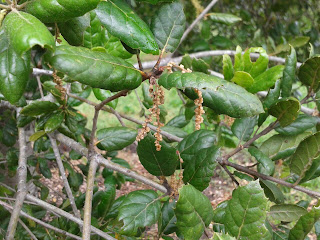
These small coast live oaks had what I'd call a moderate acorn crop last year. In autumn every time we visited the park my then 2 year old son would want to pick some acorns and taste them... and then spit them out in disgust while shouting "Ewwwwy!" It became a sort of ritual.
This year's blossom seems much more dense and verdant. It will be cool to see how that translates into an acorn crop. And it gives me about 5 months to teach my son how yummy acorns can be!
Meanwhile, as long as the oaks are blooming and my allergies are raging every burst of productivity from me takes seemingly three times the effort.
Stupid trees.

These small coast live oaks had what I'd call a moderate acorn crop last year. In autumn every time we visited the park my then 2 year old son would want to pick some acorns and taste them... and then spit them out in disgust while shouting "Ewwwwy!" It became a sort of ritual.
This year's blossom seems much more dense and verdant. It will be cool to see how that translates into an acorn crop. And it gives me about 5 months to teach my son how yummy acorns can be!
Meanwhile, as long as the oaks are blooming and my allergies are raging every burst of productivity from me takes seemingly three times the effort.
Stupid trees.
Read This
http://www.youmeworks.com/keepplanting.html
Read this. Now. My newest hero.
I was lucky enough to speak to this guy's nephew yesterday and learned his story. Gives me goosebumps.
Only problem: It has become trendy lately to come up with your own personal Rushmore of heroes, and I have been working on mine. Mine so far: J. Russell Smith, Mark Twain, Aldo Leopold, Bruce Springsteen.
Now someone's got to go.
Read. Enjoy. Marvel. Go plant some trees. Then plant some more.
Read this. Now. My newest hero.
I was lucky enough to speak to this guy's nephew yesterday and learned his story. Gives me goosebumps.
Only problem: It has become trendy lately to come up with your own personal Rushmore of heroes, and I have been working on mine. Mine so far: J. Russell Smith, Mark Twain, Aldo Leopold, Bruce Springsteen.
Now someone's got to go.
Read. Enjoy. Marvel. Go plant some trees. Then plant some more.
Subscribe to:
Posts (Atom)